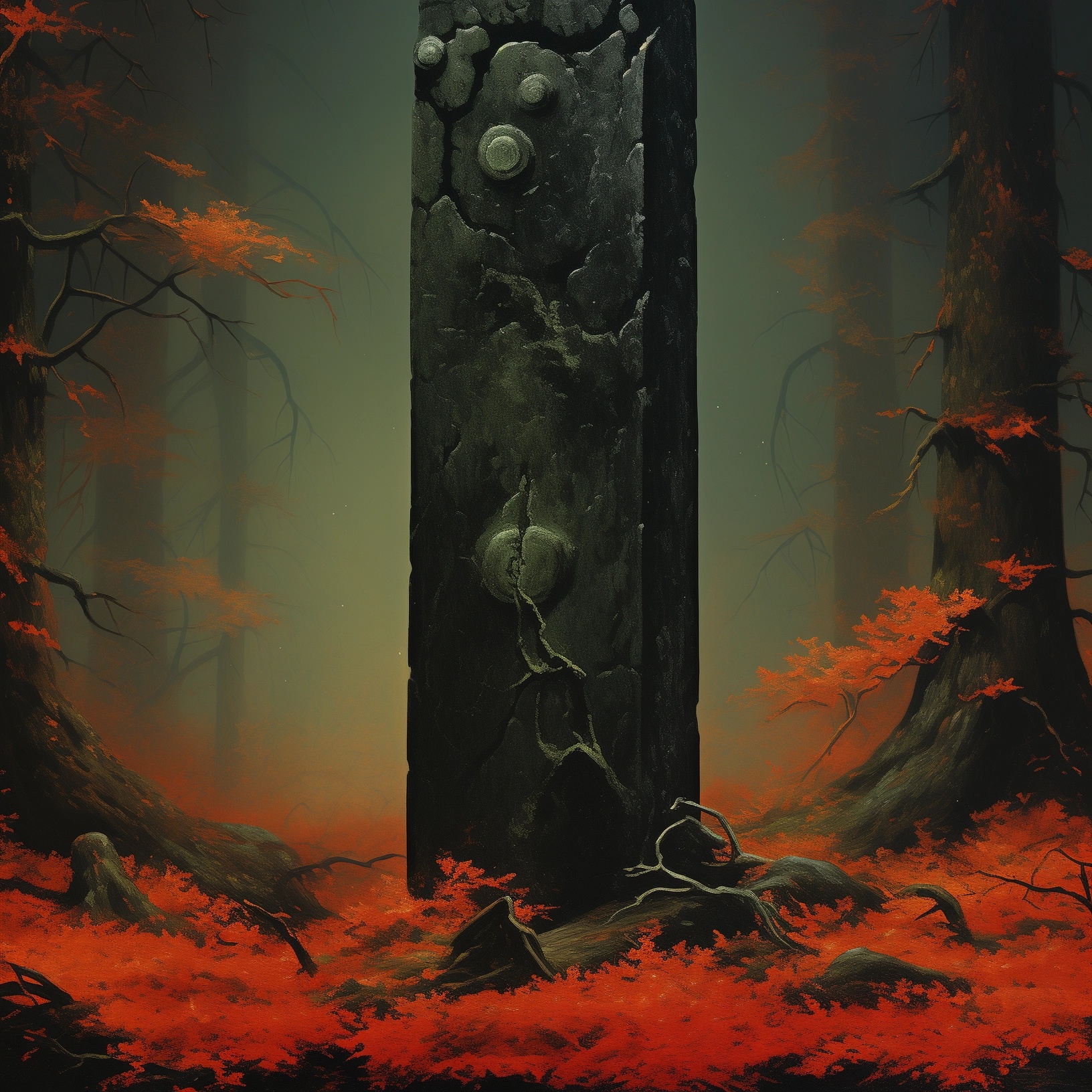

In a forest where the foliage burned with an autumnal fire, we discovered what the locals revered as "The Breathing Monolith." It stood alone, a craggy titan among the whispering trees whose leaves were the color of flames. The monolith was unlike any other, its surface a labyrinth of deep crevices that wound through the stone like veins. The locals spoke of it in hushed, reverent tones; they believed these fissures were the source of its power, that within these cracks lay the true essence of the monolith. According to their lore, the stone was not the structure, but rather the shell, the chrysalis from which the true form of the monolith emerged. They said that if one were to stand close enough, in the sacred silence of the red forest, one could hear the monolith breathe. It was a slow, rhythmic pulsation, an inhalation and exhalation of the earth that made the air shiver with vitality. This was the life of the monolith, they claimed, the breath of the gods made manifest. The stone's surface was a myriad of hues from the darkest obsidian to the palest gray, each crack a window into an unfathomable depth. The locals told tales of how the stone grew from these abyssal cracks, born from the void, expanding and contracting with the breath of the divine. To the people of the red forest, "The Breathing Monolith" was a place of worship, a sanctum where the veil between their world and the unseen was at its thinnest. Offerings of vibrant red leaves, the same shade as the forest floor, were laid at its base, a testament to their devotion. As the sun set, casting the forest in a deeper hue of blood and shadow, the monolith seemed to awaken. The temperature dropped, and the forest grew silent, as if in anticipation. And there, in the dimming light, I felt it—a faint vibration, like the heartbeat of the earth, pulsating through the soles of my feet. We left as night enveloped the forest, the image of the monolith forever etched into our memories. It remained there, a testament to the enduring belief of the locals, a sentinel of a faith as old as the cracks that defined it, and as eternal as the breath that gave it life.
