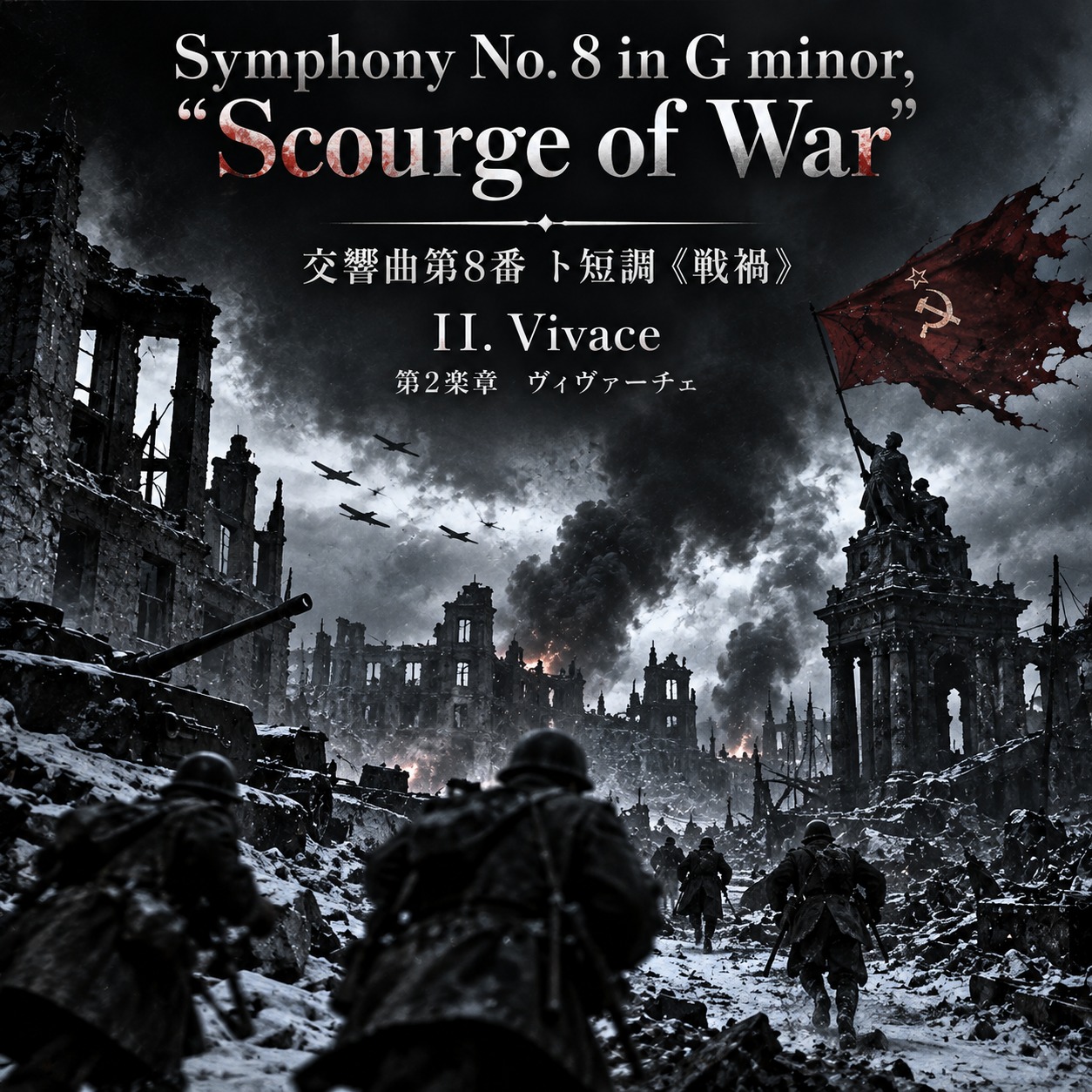

II. Vivace The Second Movement begins with rapid string figures centered on C minor. In sharp contrast to the heavy tragedy of the First Movement, the music immediately races forward—sharp, agile, and almost breathless. Yet beneath this apparent lightness lies a constant sense of unease. This is no peaceful intermezzo, but a fast movement portraying another face of war through a distorted dance. From the opening, rapid figures in the violins rise and fall continuously over regular pulses in the lower strings. Rather than singing in long melodic lines, the music advances through short, incisive gestures, repeatedly interrupted by forceful accents from brass and percussion. Despite their extraordinary agility, the strings never seem truly free. Their persistent repetition suggests machinery operating without rest, or a military system continuously sending soldiers and weapons in the same direction. The music possesses the lightness of a scherzo, but its humor is far from cheerful. Strings rush through the upper register, brass chords suddenly burst open, and exaggerated percussion strokes punctuate the texture. As these gestures rapidly alternate, their initial lightness becomes increasingly restless, sarcastic, and grotesque. Like the distorted dances found in the symphonies of Shostakovich, the music borrows the appearance of something lively while concealing violence and anxiety beneath its surface. The more obsessively its gestures repeat, the more its laughter loses all human warmth and becomes expressionless. A more strongly defined rhythmic idea eventually emerges against the fluid string writing. Above the repeated strings, the brass introduces short, forceful figures, giving the music a military character. Yet this is no disciplined or heroic march. The accents are deliberately exaggerated and the melodic contours remain angular, as though military ceremony and victory music have been transformed into caricature. In the central section, the brass becomes increasingly dominant and the orchestral sound temporarily gains greater weight. Broad, decisive brass figures are placed above the rapidly moving strings. As the same rhythms repeat, the image is no longer that of individual soldiers, but of entire formations and columns of military vehicles advancing together. Yet this march has no destination. The music expands through repetition until forward motion itself seems to become its only purpose. A military force supposedly controlled by human intention gradually transforms into an enormous mechanism incapable of stopping itself. The orchestral texture later becomes lighter, bringing woodwinds and upper strings to the foreground. Short, agile figures chase one another between instruments. The music regains its dance-like mobility, but never any sense of peace. Sharp woodwind colors and nervous string repetitions create an atmosphere of constant vigilance and unease. In the First Movement, the suffering of people caught within war was expressed through long, Romantic melodic lines. In the Second, such personal expression almost disappears. Instead, short motifs, repeated rhythms, and rapidly changing instrumental combinations portray the movement of groups and mechanisms. Human emotion has been removed, while the music continues to operate with relentless precision and speed. In the latter part of the movement, the rapid string figures from the opening return. But they now carry the weight of the military sonorities introduced in the central section. What initially seemed merely agile begins to sound like part of a vast machine of war. Rapid strings, repeated lower-string pulses, powerful brass, and percussion combine as the movement drives toward its conclusion. The final section compresses the fast-moving motifs still further. Rather than slowing down to provide a conclusion, the music maintains its Vivace momentum and rushes forward. The entire orchestra joins in short rhythmic gestures and repeated sharp chords until the movement ends almost as if suddenly cut off. There is neither certainty of victory nor time to reflect upon tragedy. It is as though an enormous machine has merely stopped for a moment, while the war itself continues. The conflict that began and expanded in the First Movement has now become institutionalized, mechanized, and transformed into routine motion. Shostakovich-like sarcastic dance, the agility of a classical scherzo, and distorted echoes of military music collide without rest. Rather than directly mourning the horrors of war, the Second Movement portrays something equally disturbing: a society in which even horror has become part of the machinery of everyday life. ーーーーーーーーーーーーーーーーーーーーーー 第2楽章:Vivace 第2楽章は、ハ短調を中心とする急速な弦楽器の運動によって開始される。 第1楽章にあった重い悲劇性から一転し、音楽は鋭く、軽快に、ほとんど息をつく間もなく駆け出す。しかし、その明るい運動の内側には常に不穏な影が潜んでいる。これは安らぎを与える間奏曲ではなく、戦争の異なる一面を、歪んだ舞曲として描く快速楽章である。 冒頭では、ヴァイオリンを中心とする細かな音型が絶えず上下し、その下を低弦の規則的な刻みが支える。旋律は滑らかに歌うのではなく、短く鋭い身振りを繰り返しながら進み、そこへ金管楽器と打楽器の強烈なアクセントが突き刺さる。 弦楽器の運動は極めて俊敏でありながら、自由に飛び回っているわけではない。一定の型に従って動き続けるその反復は、休むことなく作動する機械や、大量の兵士と兵器を一定方向へ送り続ける戦争機構の動きへと結び付いていく。 音楽にはスケルツォに近い軽さがあるが、そのユーモアは明るいものではない。 高音域を素早く駆け抜ける弦楽器、突然大きく開かれる金管楽器の和音、誇張された打楽器の一撃。これらが次々と切り替わることで、軽快さは次第に落ち着きのなさへ変わり、さらに冷笑的でグロテスクな表情を帯びていく。 ショスタコーヴィチの交響曲に見られるような、陽気な舞曲の形を借りながら、その内側に暴力や不安を忍ばせる音楽である。表面だけを聴けば活発で華やかでありながら、同じ動きが執拗に繰り返されるほど、笑いは人間的な温かさを失い、無表情なものへ変わっていく。 やがて、冒頭の流動的な弦楽器の音楽に対し、より明確な拍節を持つ楽想が現れる。 弦楽器の刻みの上で金管楽器が短く力強い音型を示し、音楽には軍楽を思わせる性格が加わる。ただし、ここで描かれるのは整然とした英雄的な行進ではない。アクセントは過剰に強調され、旋律の輪郭もどこか角張っている。 軍隊の行進や戦勝の音楽を戯画化し、その誇らしさを意図的に歪めたような場面である。 中間部に入ると、金管楽器の存在感がさらに強まり、楽章は一時的に重厚な響きへと変化する。 それまで俊敏に動いていた弦楽器の上へ、金管楽器による幅広く断定的な音型が重ねられる。特に同じリズムが繰り返される場面では、個々の兵士ではなく、隊列や軍用車両の集団がまとまって前進する光景が浮かび上がる。 しかし、この行進にも到達点はない。 音楽は同じ運動を繰り返しながら膨張し、前進することそのものが目的となっていく。人間の意思によって動かされていたはずの軍隊が、いつしか自ら止まることのできない巨大な装置へ変わっていく。 その後、管弦楽の編成が軽くなり、木管楽器と高音弦を中心とする機敏な音楽が前面に現れる。 音型は短く、素早く、互いに追い掛け合うように受け渡される。音楽は再び舞曲的な身軽さを取り戻すが、ここにも穏やかさはない。木管楽器の鋭い音色と弦楽器の細かな反復によって、落ち着きなく周囲を見回すような神経質さが生まれている。 第1楽章では、戦争の中に取り残された人間の悲しみが、ロマン派的な長い旋律によって描かれていた。 それに対して第2楽章では、個人の内面を歌う旋律はほとんど前面に出ない。短い動機、反復されるリズム、次々と切り替わる楽器の組み合わせによって、集団と機構の運動が描かれる。 人間の感情が排除されたまま、音楽だけが正確かつ猛烈な速度で動き続けていく。 後半では、冒頭の急速な弦楽器の音型が再び現れる。 これは単純な反復ではなく、中間部で加わった軍楽的な響きや金管楽器の重量を取り込み、より強い圧力を伴って帰ってくる。冒頭ではまだ軽快に聞こえていた音楽が、再現された時には巨大な戦争機械の一部として聞こえ始める。 弦楽器の細かな運動と低弦の刻み、金管楽器の強奏、打楽器の衝撃が重なり、楽章は最後の局面へ向かう。 終結部では、それまで繰り返されてきた急速な動機がさらに凝縮される。 音楽は速度を落として結論を導くのではなく、Vivaceの勢いを保ったまま突進する。管弦楽全体が短いリズムを共有し、鋭い和音を連続して打ち込むことで、楽章は突然切断されるように終わる。 そこに勝利の確信も、悲劇を振り返る時間もない。 巨大な機械が一時的に停止しただけで、戦争そのものはなお続いている。第1楽章で始まり、拡大していった戦争は、この第2楽章において、制度化され、機械化され、日常的な運動へと変貌する。 ショスタコーヴィチを思わせる冷笑的な舞曲、古典的なスケルツォの俊敏さ、そして軍楽を歪めた金管楽器の響き。 それらが休みなく交錯する第2楽章は、戦争の悲惨さを直接嘆くのではなく、悲惨な状況さえも日常の動作として処理していく社会の異常さを描いている。

0/500