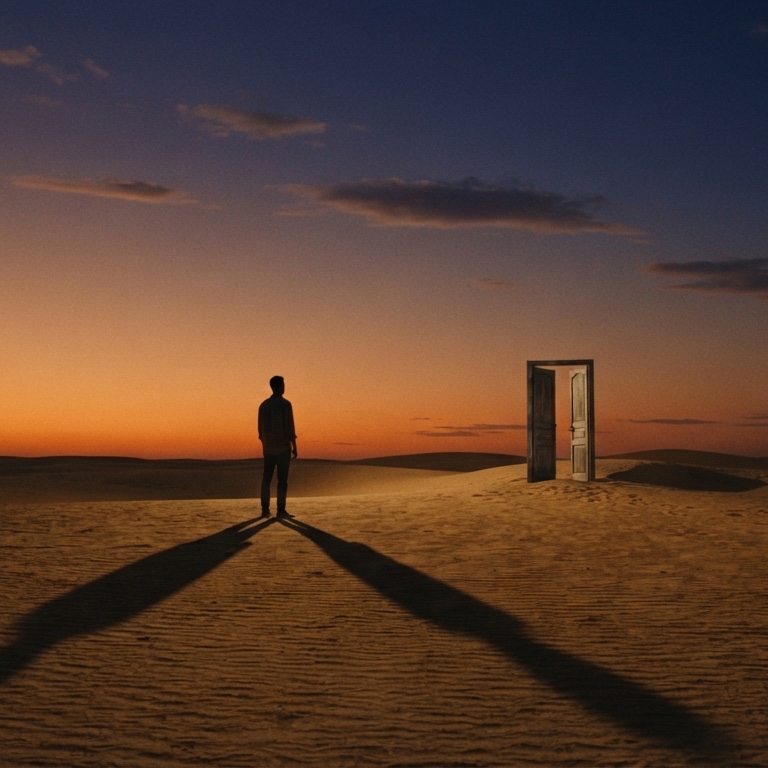
[Seven Doors is a song cycle built on seven doors, seven life stories, and seven iconic music styles paired with their native regional instruments. Each door represents a distinct stage of one man's life - and a musical tradition chosen not for decoration, but because its cultural origin and instrumental voice genuinely embody that stage's emotional truth. Just as world cuisines each carry a distinct, recognizable identity (Italian, Chinese, and so on), these seven genres are each globally iconic in their own right - Celtic folk, flamenco, blues/gospel, tango, Middle Eastern Hijaz folk, West African kora music, Chinese guqin - so that the listener recognizes the "genre" instantly, the way one recognizes a cuisine by taste. The same male voice narrates all seven doors, aging and transforming across the cycle, until the final door circles back to the first.] [Seven Doors - Door 5 - Solitude / Surrender Middle Eastern Hijaz Folk Having exhausted control and grasping in love, he walks alone into open wilderness. There is no one left to possess, no one left to flee - only himself, and a silent expanse. He finally stops searching for answers and learns to let uncertainty simply exist. Middle Eastern folk, particularly music built on the Hijaz mode, is the cultural archetype of spiritual searching and solitary wandering - the mode itself carries an unresolved tension (its signature augmented second interval) that is mysterious and not easily settled, mirroring the psychological task of accepting uncertainty rather than forcing an answer. The oud replaces tango's clinging violin slides with a broader, more improvisational, monologue-like melodic line - as if he is finally speaking only to himself. The ney flute's breath-like tone, sitting somewhere between pitch and pure breathing, is the first instrument in the series to blur the line between "playing" and simply "existing," echoing the bridge's line, "I stopped searching for the answers / And let the silence sing." The darbuka and frame drum are deliberately sparse, no longer driving emotion the way Door 2's palmas did, but instead marking the passage of time itself - like a heartbeat in the desert. This is the series' turning point: the first four doors move outward (rebellion, reckoning, possession); Door 5 begins turning inward (surrender).] [Intro] I came back to the first house The door was never closed It waited through the silent years It was always home [Verse 1] I ran through the streets at night Fire above and stone below I outran the boy I was But lost the ones I used to know The flames were never there to end me They only changed my soul [Chorus] I came back to the first house The door was always here Every road became a circle Home remembered me [Verse 2] I walked through a city at 3 AM No money, just one faithful word Every wrong turn led me somewhere Every whisper still was heard I never knew if hope was waiting Still I kept moving on [Chorus] I came back to the first house The door was always here Every road became a circle Home remembered me [Verse 3] I walked into a darkened hall No light, no voice, no sound Only footsteps kept beside me Only my heartbeat now I walked until the fear grew quiet And silence became home [Chorus] I came back to the first house The door was always here Every road became a circle Home remembered me [Bridge] I stood inside another city Words I could not understand Still the songs all sounded familiar Like they knew just who I am I stopped searching for the answers And let the silence sing [Verse 4] I walked down an old wooden hallway The wind moved through every door The quiet spoke louder than thunder Like never before Everything I thought I'd lost Was waiting at the start [Final Chorus] I came back to the first house The door was never locked Every road became a circle Every loss became a guide I walked through seven different worlds But I never left this home [Outro] The door was always here Waiting for me Waiting for me
