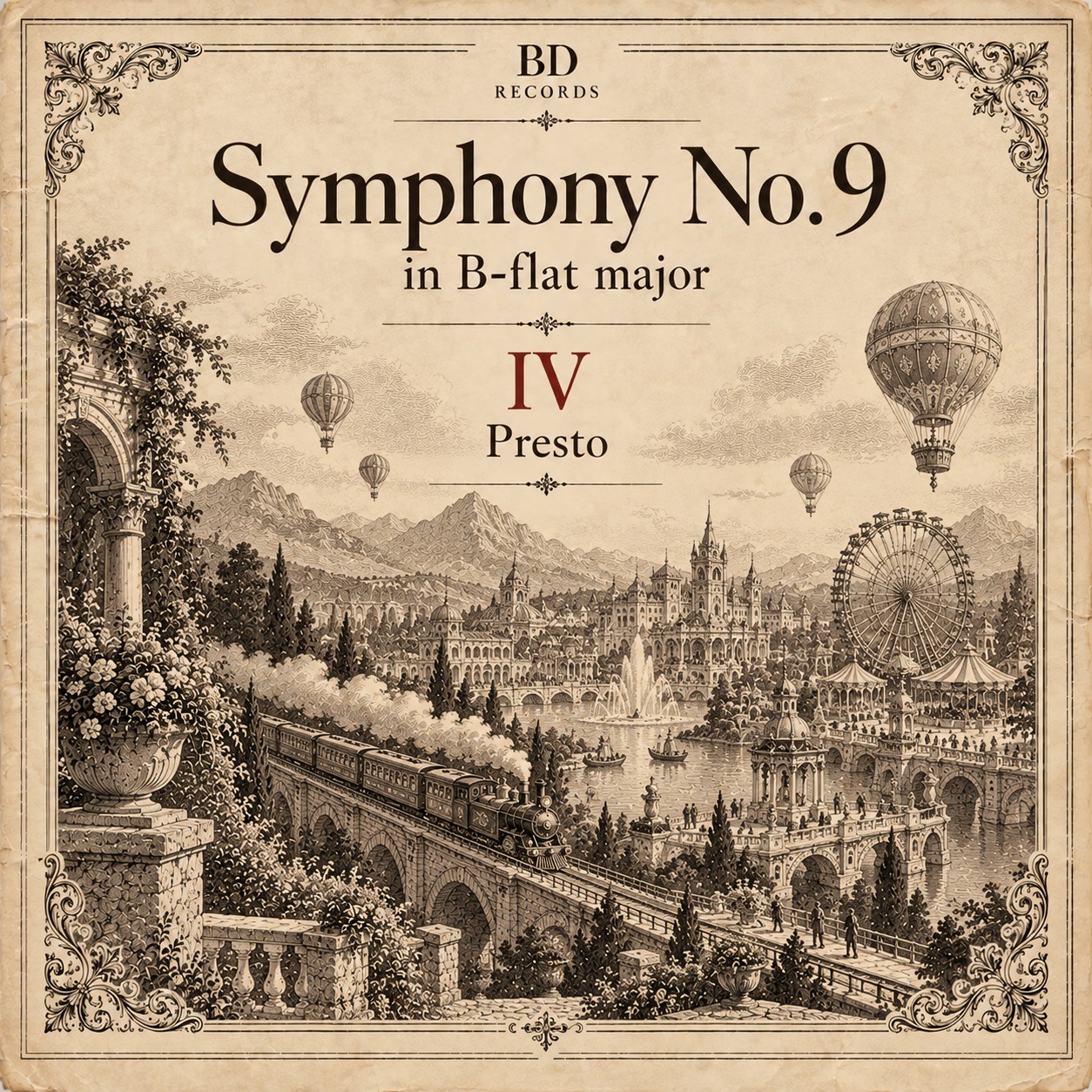

Movement IV: Presto — D major The fourth movement is the lightest and most brilliant movement of the symphony, written with the character of a Johann Strauss polka in mind. Like the third movement of Tchaikovsky’s Symphony No. 6, “Pathétique,” it is positioned as a movement of such momentum and exhilaration that it can almost be mistaken for the finale. The original inspiration came from the composer’s own fondness for sightseeing trains. To this was added the excitement and anticipation of visiting a theme park, creating music that suggests a train rushing forward as one landscape after another passes by. From the opening, the strings immediately launch into rapid motion, and the principal theme appears with almost no introduction. Woodwinds move lightly above the constantly active strings, while the brass adds accents at key moments, continuously pushing the music forward. The central theme is clear and memorable, returning repeatedly throughout the movement. Rather than being reproduced mechanically, however, each return changes the instrumental combinations and density of the accompaniment. The effect is almost like remaining aboard the same train while the scenery outside the window constantly changes. At one point, the rapid motion gives way to a broader, more lyrical melody. Even here, the underlying movement never completely stops, with the strings continuing to pulse beneath the melody. As a result, the sense of speed remains intact even during the more lyrical passages, which function as brief moments of relaxation before the principal theme returns. From the middle of the movement onward, woodwinds, strings, and brass rapidly exchange short phrases, producing constantly shifting orchestral colors. Cymbals, bass drum, and other percussion expand the sound beyond the lightness of a traditional polka, giving the movement sufficient weight and scale to function within a symphony. When the opening theme returns clearly in the latter part of the movement, the music drives toward its conclusion with almost no loss of momentum. Rapid strings, agile woodwinds, brilliant brass, and percussion combine in a final surge, culminating in a vivid full-orchestral cadence. Although lasting only a little over three minutes, the movement leaves one of the strongest impressions in Symphony No. 9 through its memorable theme, continuous motion, and constantly changing orchestral colors. While the fifth movement provides the symphony’s inward conclusion through the human voice, the fourth represents its final purely orchestral climax. It creates the exhilaration of an apparent ending before giving way to the true finale. ーーーーーーーーーーーーーーーーーーーーーーー 第4楽章:Presto — ニ長調 第4楽章は、ヨハン・シュトラウスのポルカをイメージして書かれた、本交響曲中もっとも軽快で華やかな楽章である。チャイコフスキーの交響曲第6番《悲愴》第3楽章のように、終楽章を思わせるほど強い推進力と高揚感を持つ楽章として置かれている。 着想の原点となったのは、作曲者自身が好む観光列車である。そこへテーマパークを訪れたときのような期待感や高揚感を加え、列車が次々と景色を通り過ぎていくような音楽として構成した。 冒頭から弦楽器が高速で走り出し、ほとんど助走を置かずに明快な主題が姿を現す。細かく刻まれる弦の上を木管楽器が軽やかに動き、金管楽器が要所にアクセントを置くことで、音楽は絶えず前方へ押し進められる。 中心となる主題は非常に明快で、一度提示されたあとも楽章の各所に繰り返し現れる。しかし、同じ形を機械的に反復するのではなく、楽器の組み合わせや伴奏の密度を変化させながら再登場するため、あたかも同じ列車に乗ったまま窓の外の風景だけが次々と変化していくような感覚を生み出している。 途中では冒頭の疾走から一転し、より大きく歌う旋律が現れる。ここでも基本的な運動は完全には止まらず、旋律の背後で弦楽器が脈動を続ける。そのため抒情的な場面へ移っても音楽の速度感は失われず、短い休息を挟みながら再び主題へ戻っていく。 中盤以降では木管、弦、金管が短い楽句を次々と受け渡し、音楽の色彩が目まぐるしく変化する。そこへシンバルやバスドラムなどの打楽器が加わることで、伝統的なポルカの軽快さを保ちながら、交響曲の一楽章として十分なスケールを持つ響きへ拡大されている。 そして後半、冒頭主題が再び明確な姿で戻ると、音楽はほとんど速度を緩めることなく終結へ向かう。弦楽器の高速な運動、木管の軽快な動き、金管と打楽器による華やかなアクセントが重なり、最後は全管弦楽による鮮烈な終止へ到達する。 約3分余りというコンパクトな楽章でありながら、明快な主題、絶え間ない運動、次々と変化する管弦楽の色彩によって、第9番の中でも特に強い印象を残す楽章となった。 第5楽章が声楽によって交響曲の内面的な結論を語るのに対し、この第4楽章は純粋な管弦楽による最後の頂点である。一度ここで交響曲そのものが終わったかのような高揚を作り出した後、本当の終楽章へと道を譲る。

0/500