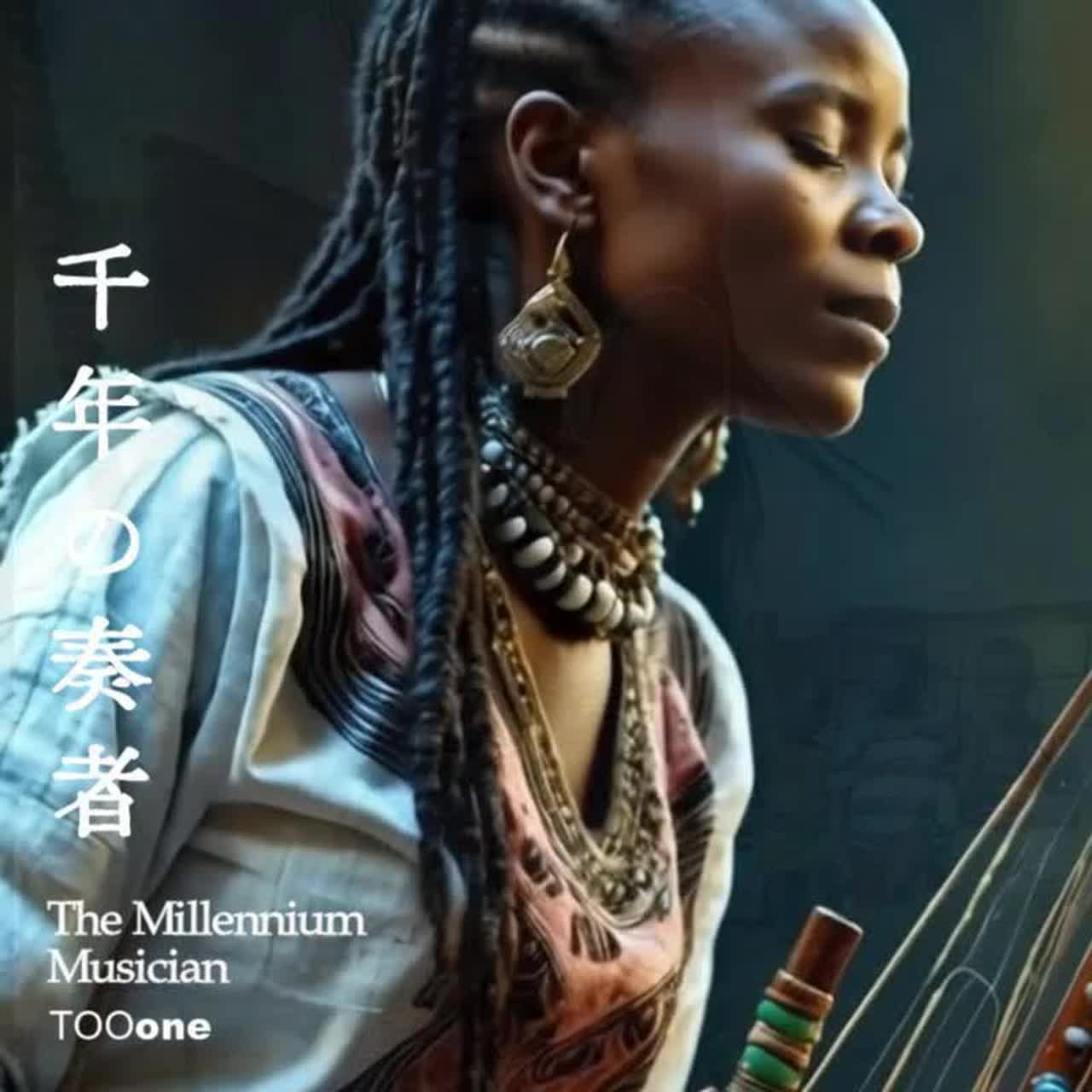

千年の奏者 — The Millennium Musician [瓢箪からコラ — 01] ────────────────── 新しい実験シリーズをスタートさせました。 狙いは、Suno v6.0で須野さんに見捨てられた(?)ワールドミュージック系のニッチな楽器の音を、Studio内蔵のシンセサイザーを駆使して取り戻そうというもの。 ハンドパン、アイヌのトンコリ、インドのシタールなど、かなり適当に「それっぽい音」で済まされて、がっかりしている人も多いはず。いや、そんなに多くはないか……。 第1回は、西アフリカの**コラ(Kora)**です。 コラは21本の弦を持ち、ひょうたんで作られた共鳴胴を持つ楽器。外見は独特ですが、音の仕組みとしてはハープに近い弦楽器です。 これまでにもコラを使った曲を何曲か生成してきましたが、v6になってからは、エフェクトを少しかけたアコースティックギターにしか聞こえなくなり、しばらく制作をやめていました。 とはいえ、過去曲には気に入っているものも多い。なんとかコラらしい音を取り戻せないものか。 そこで今回は、「StudioのMIDI機能と内蔵モジュラーシンセを組み合わせて、コラの音色を再構築する」ことにしました。 Studioの利用環境が必要な実験ですが、MILO-1080など同系統のシンセを使う場合にも、多少参考になるかもしれません。 ────────── 音色を再構築する手順 ────────── 細かなパラメーターの説明は省略して、大まかな流れを紹介します。 SUNOに内されたシンセサイザーWAVETABLEの使い方は 以下のサイトで解説しています⏬️ https://tooone21.substack.com/p/sunowavetable 1. 修正したい楽器の演奏トラックをMIDIデータに変換する。 2. Studioでモジュラーシンセを呼び出す。 3. 内蔵チャットボットに、再現したい楽器の音色を言葉で指示する。 4. 生成された音を確認し、パラメーターを調整する。 5. 比較と修正を繰り返し、目標の音に近づける。 再現のポイントは、大きく3つ。 --◎発音:弦を弾く、叩くなど、音が生まれる瞬間の質感。 --◎共鳴:弦の振動が胴に伝わり、どのように響くか。 --◎減衰:アタックから余韻が消えるまで、音がどう変化するか。 言葉にすれば簡単ですが、これがなかなか難しい。 自分の耳で判断するだけでなく、必要に応じてStemを書き出し、 AIに分析してもらって修正点を言語化する。 それをもとにパラメーターを調整する、という作業を繰り返します。 ◎あ、それでもかなり面倒くさいわ。 理想をいえば、参考音源をアップロードして、 チャットボットに「この音と同じにして」とお願いするだけで済ませたいところです。 ────────── 今回の仕上がり ────────── 元のSuno音源は、ナイロン弦のアコースティックギター風。 一方、モジュラーシンセで作った音は、胴鳴りと余韻が豊かになったものの、少し金属的な響きが残っています。 そこで今回は、「元の生成音とシンセで再構築した音をダブルトラックで重ね、バランスを調整」しました。 公開しているのは、そのミックス版です。 まだ完全なコラとはいえませんが、初回の実験としては、なかなか面白いところまで来たと思います。 今後は、さらに次の要素を加える予定です。 - 指が弦に触れる際の微細なノイズ - 指で弦をミュートするときのノイズ - 複数の弦が共鳴する余韻や、ピアノのサステインペダルに似た残響効果 今回は、シンセの発振波形、音色パラメーター、フィルター、アタックと減衰、共鳴の調整まで。 まだまだ先は長そうですが、まずは第1回。 ───瓢箪からコラ。さて、どこまで本物に近づけるでしょうか。─── ────────── The Millennium Musician [Out of a Gourd Comes a Kora — 01] ────────── I've started a new experimental series! The idea is to bring back the sounds of niche world-music instruments that Suno v6.0 seems to have abandoned, using the synthesizers and sound-design tools inside Suno Studio. Handpans, the Ainu tonkori, Indian sitars, and other distinctive instruments often seem to get replaced by rather generic approximations. I'm sure plenty of people are disappointed. Well, maybe not ’that’ many... For the first experiment, I'm focusing on the ”kora ”, a traditional West African instrument. The kora has 21 strings and a resonating body made from a large calabash gourd. Although its construction is quite distinctive, it belongs to the harp-lute family and has a sound closer to a harp than a guitar. I've generated several kora-based pieces in the past. But since v6, the instrument has often sounded more like an acoustic guitar with a few effects added. So I stopped making kora music for a while. Still, I have quite a few older compositions that I really like, and I wanted to find a way to bring that characteristic kora sound back. This time, I'm combining **Studio's MIDI functionality with its modular synthesizer to reconstruct the instrument's tone**. The experiment requires access to Suno Studio, but some of the ideas may also be useful with similar synthesizers, including MILO-1080. ────────── How I'm Rebuilding the Sound ────────── I'll skip the detailed parameter settings and focus on the general workflow. 1. Convert the original instrument performance into MIDI data. 2. Load a modular synthesizer in Studio. 3. Describe the desired instrument sound to the built-in AI chatbot. 4. Listen to the result and adjust the synthesizer parameters. 5. Repeat the process until the sound gets closer to the target. There are three main elements to consider: - **Excitation:** How the sound begins, whether a string is plucked, struck, or otherwise set into vibration. - **Resonance:** How the vibrating string interacts with the instrument's body and produces its characteristic tone. - **Decay:** How the sound changes from the initial attack to its final fading resonance. Sounds simple enough. Unfortunately, it isn't. I listen carefully, export stems when necessary, and use AI analysis to help identify and describe the differences between the synthesized sound and the instrument I'm trying to reproduce. Then I adjust the parameters and try again. And again. Come to think of it, that's still a lot of work. Ideally, I'd like to upload a reference recording and simply tell the chatbot, "Make it sound exactly like this." Perhaps someday! ────────── The Result So Far ────────── The original Suno-generated kora sounds somewhat like a nylon-string acoustic guitar. The modular-synth version has a fuller body resonance and a longer, more noticeable decay, although it also introduces a slightly metallic quality. For this first experiment, I decided to **layer the original generated instrument with the reconstructed synthesizer sound**, adjusting the balance between the two. The track I'm sharing is a mix of both. It's certainly not a perfect recreation of a real kora, but I think the first experiment has produced some interesting results. Next, I plan to add more of the subtle physical details that make a real string instrument feel alive: - Small noises caused by fingers touching the strings - Muting noises from stopping string vibrations - Overlapping string resonances and sustained vibrations, somewhat like the effect of a piano's sustain pedal For now, I've focused on oscillator waveforms, tone shaping, filters, attack, decay, and resonance. There's still plenty of work ahead. But this is only experiment number one. ─ Out of a gourd comes a kora. Let's see how close we can get to the real thing─ --------------------------------------------------- 🎶 千年の奏者 The Millennium Musician --------------------------------------------------- 🎵 Remake 千年の奏者 The Millennium Musician ( 公開終了) https://suno.com/song/ee4fd224-b76e-401a-b935-54cf53f21582 🎵 Music & Arrangement: SUNO ver.6.0 🎹 Structure & Chord Plan: TOOone with Cubase 15 🎧 Genre Styling: [ lofi ]✖[ African primitivism ]✖[ chilled grooves ] 🎨 Cover Art Plan: TOOone 🖌️ Illustration: 🎬 Music Video: ・Generation: ・Editing: Filmora 16 ----------------- Lyric ----------------- 女神はときどき 地上におりて KORAをひき 聞く人いやす 吟遊詩人に 闇から光が 生まれたわけを 歌で伝える 千年をこえても 歌いつづけよと メロディーをあみ 千年をこえても 歌いつづけよと リズムをきざむ 地上でKORAを ひくものたちよ 歌いつづけるかぎり 希望はきえない 語りつぐ限り 命はつながり 輪を描く 千年をこえても 歌いつづけよと メロディーをあみ 千年をこえても 歌いつづけよと リズムをきざむ うたいつぐ限り 命はつながり らせんをのぼる 地上でKORAを ひくものたちよ 歌いつづけるかぎり 希望はきえない ------------------------ Once, the goddess descended to the red dust to give thanks to the spirits of the land. She called the singers, bade them gather— to sing on, to play the kora, to carry the song. She rides the wind, singing her love to the open sky. She calls the bard to echo her voice, to pluck the strings, and carry it on. The goddess speaks— the world began from darkness deep and silence wide. She placed the tale into the bard’s open hands, and gifted him the kora’s light. “Sing on for a thousand years, and still a thousand more. Let rhythm be your fire, and memory your song.” And so they did— the poets of the earth. Across the windswept centuries they sang what must be sung: wisdom carried in sound, truth braided in tone. As long as hope survives, the tale is told anew. As long as hands remember strings, the circle stays unbroken.
