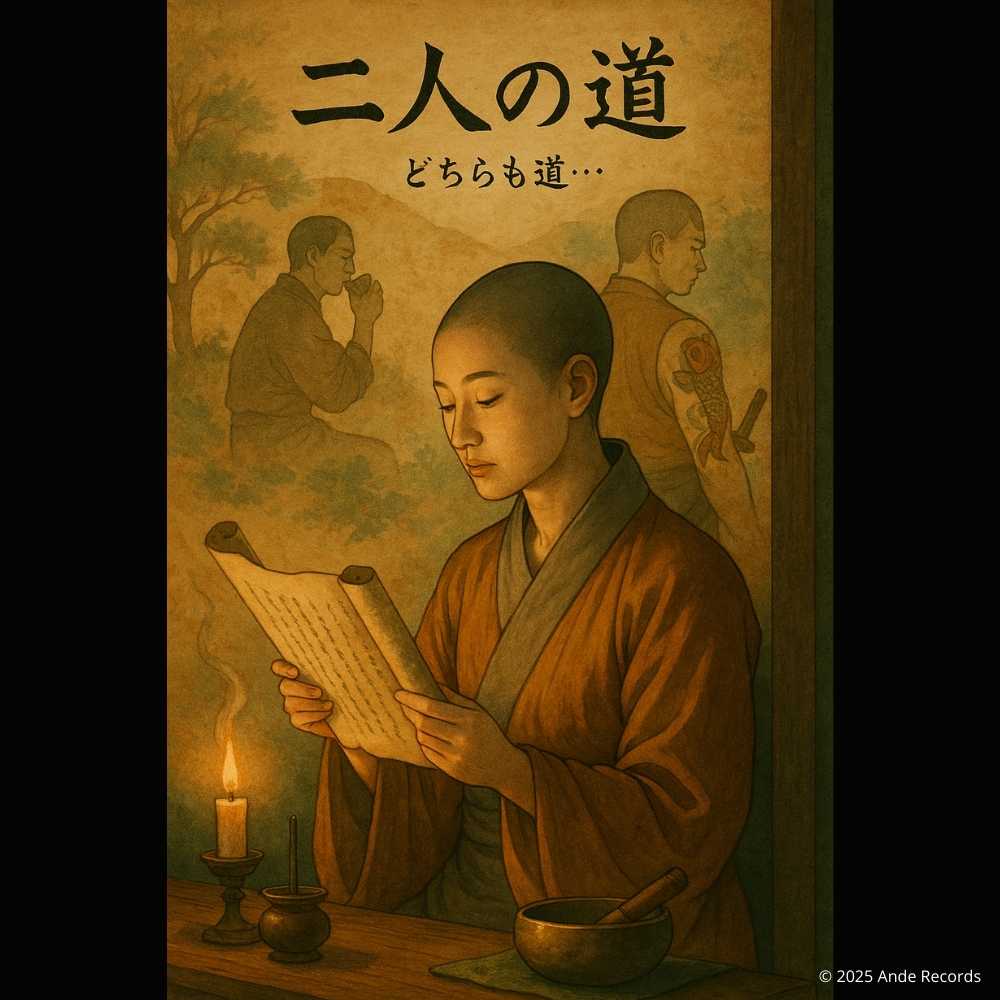

[Intro] [Temple bells ring three times] [Singing bowl resonates] [Shakuhachi - slow, contemplative melody] [Koto enters gently] [Spoken - Opening] Kike Kore wa mukashi no hanashi Futari no kyoudai no monogatari Giri to ninjo no aida de Erabanakute wa naranakatta otoko-tachi [Pause - Instrumental] [Shakuhachi contemplative] [Part 1 - First Brother's Path] Hitori no otoko wa Oyabun no meirei wo uketa Mottomo shitashii tomodachi wo Korosanakereba naranai to Sono yoru Hitori sake wo nonda Namida wo nagashi Demo giri wo mamotta Ashita no asa Yaranakute wa naranai koto wo shitte Kokoro wa hikisakerareta Shikashi michi wa kimatte ita [Pause] [Temple bell] [Koto gentle phrase] Kore ga giri no michi Tsurai kedo Yakusoku wo mamoru koto Sore ga kare no sentaku datta [Instrumental Interlude] [Shakuhachi and koto dialogue] [Singing bowl sustains] [Part 2 - Second Brother's Path] Mou hitori no otoko wa Sono kogeki wo uketa Shikashi ikite ita Soshite rikai shita Tomodachi wa shikata naku yatta Ayamachi wa oyabun ni aru Dakara samurai no kokoro de Tadashii michi wo eranda Kizu darake demo Oyabun no mae ni tatta "Omae ga machigatte iru" Soshite kataki wo totta [Pause] [Temple bell] [Shakuhachi mournful note] Kore ga seigi no michi Kiken demo Tadashii koto wo suru Sore ga kare no sentaku datta [Instrumental Reflection] [All instruments softly] [Space between sounds] [Meditative atmosphere] [Part 3 - The Lesson] Futari tomo Jibun no michi wo eranda Hitori wa giri wo Hitori wa seigi wo Dochira ga tadashii ka? Sore wa watashi-tachi ga Kimeru koto de wa nai Futari tomo sono michi de Sonchō sa reru beki da [Pause] [Singing bowl] Jinsei wa tokidoki Erabanakute wa naranai Kanzen na kotae no nai Sentaku wo Sono toki Watashi-tachi wa Jibun no kokoro ni Tadashiku nakereba naranai [Bridge - Deeper Reflection] Giri wa taisetsu Ninjo mo taisetsu Shikashi tokidoki Futari wa tatakaau Soshite sono toki Watashi-tachi wa kurushimu Naze naraba Dochira mo suteru koto ga dekinai kara [Pause] [Temple bells - three rings] [Shakuhachi slow, wise melody] [Closing] Kono hanashi wa owaranai Kyoudai wa mada ikite iru Hitori wa tsumi to tomo ni Hitori wa jiyu to tomo ni Shikashi futari tomo Jibun no sentaku no omomi wo Mainichi kanjite iru Sore ga ningen de aru to iu koto da [Final Wisdom] Kiite kureta anata-tachi Kono monogatari wo Mune ni kizande hoshii Jinsei wa Kantan na sentaku bakari de wa nai Shikashi dono michi wo erande mo Sonchō wo motte aruku beki da [Outro] [Shakuhachi fades slowly] [Koto single note] [Temple bell - single ring] [Singing bowl resonates and fades] [Silence] Futari no michi... Dochira mo michi... [Complete silence] ----------------------------------------------------------------------------------------------------------------------------------------------------- English Translation [Intro] [Temple bells ring three times] [Singing bowl resonates] [Shakuhachi - slow, contemplative melody] [Koto enters gently] [Spoken - Opening] Listen This is a story from the past A tale of two brothers Between duty and human feeling Men who had to choose [Pause - Instrumental] [Shakuhachi contemplative] [Part 1 - First Brother's Path] One man Received the boss's order His closest friend Must be killed That night He drank sake alone Shed tears But upheld his duty Tomorrow morning Knowing what must be done His heart was torn But the path was decided [Pause] [Temple bell] [Koto gentle phrase] This was the path of duty Painful, yet To keep one's word That was his choice [Instrumental Interlude] [Shakuhachi and koto dialogue] [Singing bowl sustains] [Part 2 - Second Brother's Path] The other man Received that attack But he lived And he understood His friend had no choice The fault lay with the boss So with a samurai's heart He chose the righteous path Covered in wounds He stood before the boss "You are wrong" And took his revenge [Pause] [Temple bell] [Shakuhachi mournful note] This was the path of justice Dangerous, yet To do what's right That was his choice [Instrumental Reflection] [All instruments softly] [Space between sounds] [Meditative atmosphere] [Part 3 - The Lesson] Both of them Chose their own path One chose duty One chose justice Which was correct? That is not for us To decide Both deserve respect For their paths [Pause] [Singing bowl] Life sometimes Forces us to choose Decisions with no Perfect answer In those moments We must be True to our own Heart [Bridge - Deeper Reflection] Duty is important Human feeling is important But sometimes They fight each other And in those times We suffer Because We cannot abandon either [Pause] [Temple bells - three rings] [Shakuhachi slow, wise melody] [Closing] This story doesn't end The brothers still live One with his guilt One with his freedom But both Feel the weight of their choices Every day That is what it means to be human [Final Wisdom] You who have listened To this story Please carve it in your hearts Life is not Only simple choices But whichever path you choose Walk it with dignity [Outro] [Shakuhachi fades slowly] [Koto single note] [Temple bell - single ring] [Singing bowl resonates and fades] [Silence] Two paths... Both are paths... [Complete silence] ----------------------------------------------------------------------------------------------------------------------------------------------------- The concluding chapter of the yakuza brothers trilogy, told as a zen legend by a monk at a temple. Where the first two songs were immersed in the emotional immediacy of impossible choices, this final piece steps back to view the entire story with philosophical distance and compassion. A zen master tells the tale of two brothers caught between giri (duty) and ninjo (human feeling), honoring both their paths without judgment. The musical approach is meditative and spacious, allowing traditional Japanese instruments to breathe fully. Shakuhachi flute serves as the primary voice, sometimes commenting on the story, sometimes simply being present. Koto provides gentle texture. The production is deliberately spacious - silence is as important as sound, creating a contemplative temple environment where this ancient story might be told. The closing reveals the story continues: the brothers still live, one carrying guilt, one carrying freedom, both feeling the weight of their choices every day. "That is what it means to be human." The monk asks listeners to carve this story in their hearts, recognizing that life offers not only simple choices, but whichever path we choose, we should walk it with dignity. By presenting the story as legend told by a zen observer, this third installment provides closure without judgment, honors both brothers' decisions, acknowledges ongoing consequences, and extracts philosophical wisdom about impossible choices. The meditative musical approach and spacious production create contemplation rather than drama - perfect for this reflective trilogy conclusion. ----------------------------------------------------------------------------------------------------------------------------------------------------- © 2025 Ande Records Lyrics by Ande All rights reserved. https://ande-records.se/
