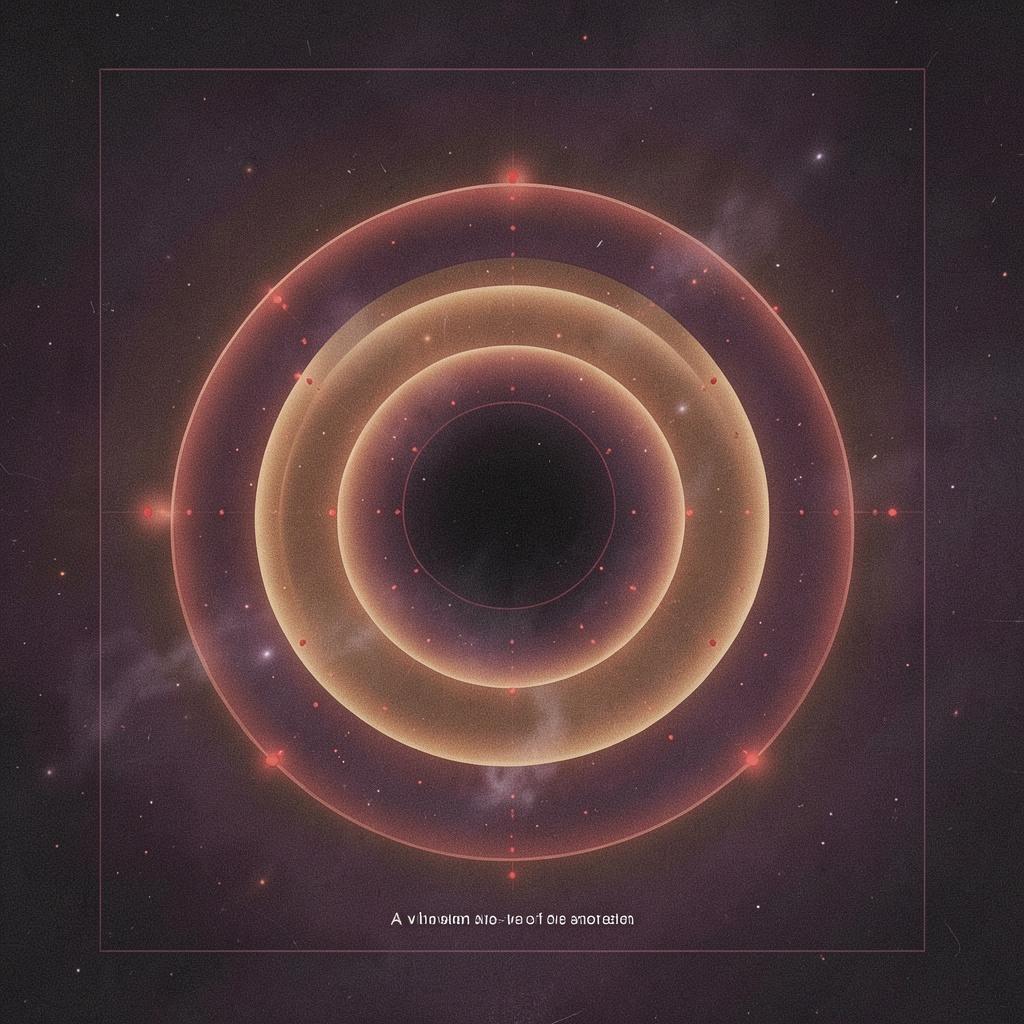

The Shell Hypothesis — simple version You know how an atom has layers? The middle part, then rings around it where electrons live. Each ring is a shell. Shell 1, shell 2, shell 3, further and further out. Now look at a solar system. Sun in the middle, planets in rings around it. Same basic shape, bigger scale. Now look at a galaxy. Star in the middle, stars orbiting around it in rings. Nature keeps using the same pattern at every size we've ever looked at. So here's the question: does it stop at galaxies? Or does it keep going? Our galaxy is part of a cluster of galaxies. That cluster might be shell 0 — the thing we're inside of. The Little Red Dots that JWST found — they're all roughly the same distance away, they all look the same color, they're spread across the sky in what might be an even pattern. That's what a shell looks like from the inside. Shell 1 — the next layer out. Each one of those red dots might not be a weird early universe object. It might be an entire cluster of trillions of galaxies so far away it looks like a single point. Just like our whole cluster would look like a single dot from that distance. The red color? Light stretches when it travels a long distance through expanding space. Maximum distance equals maximum stretch equals red. Same reason a siren sounds different driving away from you. What's actually confirmed: LRDs are real, uniform, anomalous, and the standard model is struggling to explain them. What's hypothesis: that they're neighboring clusters at a shell boundary rather than early universe objects. What would prove it: finding that the spacing between LRDs matches the spacing between galaxy clusters scaled up — same geometry, bigger layer.
