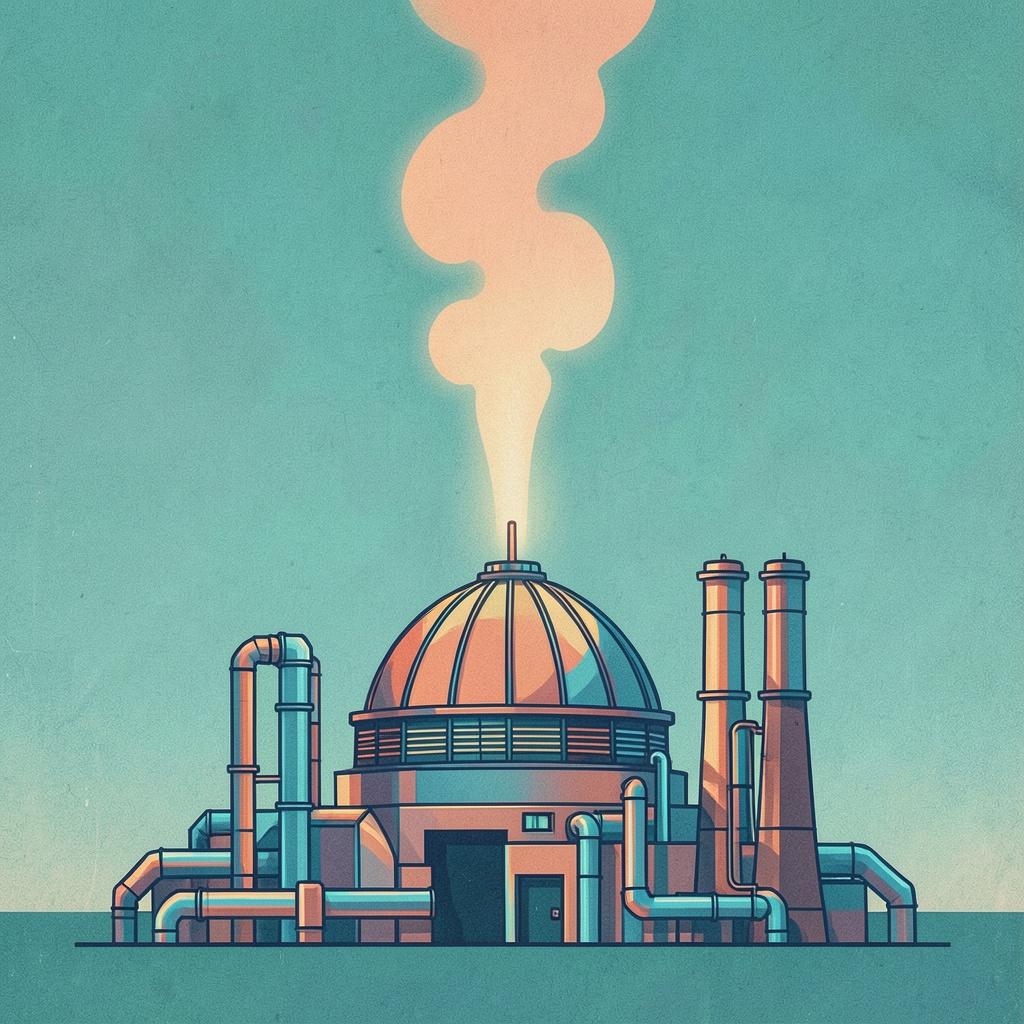
[Verse 1] Ever wonder how nuclear power plants work? It sounds like sci-fi, but it's really just a way to heat water It works like this: it all starts with uranium A metal mined from rocks, refined and shaped into tiny pellets Each one the size of a sugar cube Holds as much energy as a ton of coal [Verse 2] The pellets get stacked into fuel rods Which are just metal tubes; the rods get bundled together Then loaded into the reactor core Now here's the cool part: uranium is unstable Its atoms want to break apart When one splits, it releases heat and some neutrons That's called fission [Verse 3] Those neutrons hit nearby atoms and split them too More heat, more neutrons, more splits Control rods made of boron slide in and out, absorbing neutrons More rods in, reaction slows; emergency, drop them all [Verse 4] So what happens with all that energy? The fuel rods are surrounded by water inside the reactor The fission heats the water, which heats more water into steam The steam spins a turbine, the turbine spins a generator Electricity flows out to the grid Giant cooling towers you see from the highway That's not smoke, it's steam [Verse 5] So will we run out of uranium? Known reserves could last over 200 years And there's more dissolved in seawater than we'd ever need Are nuclear reactors dangerous? They can have accidents, but not nuclear explosions Chernobyl, that was bad, really bad But technically it was a steam explosion, not a bomb Still a disaster, just a different kind [Verse 6] Now we have better backup power, better cooling systems, stricter oversight What about the radiation? Layers of steel and concrete keep it in And the waste, stored on-site, sealed and monitored for decades So why don't we build more reactors? They're expensive, billions of dollars and a decade to construct And a few high-profile disasters made the public nervous 94 reactors run in the US today, providing 19% of our electricity Nuclear power isn't as scary as it sounds No pools glowing green, just atoms splitting, creating steam
