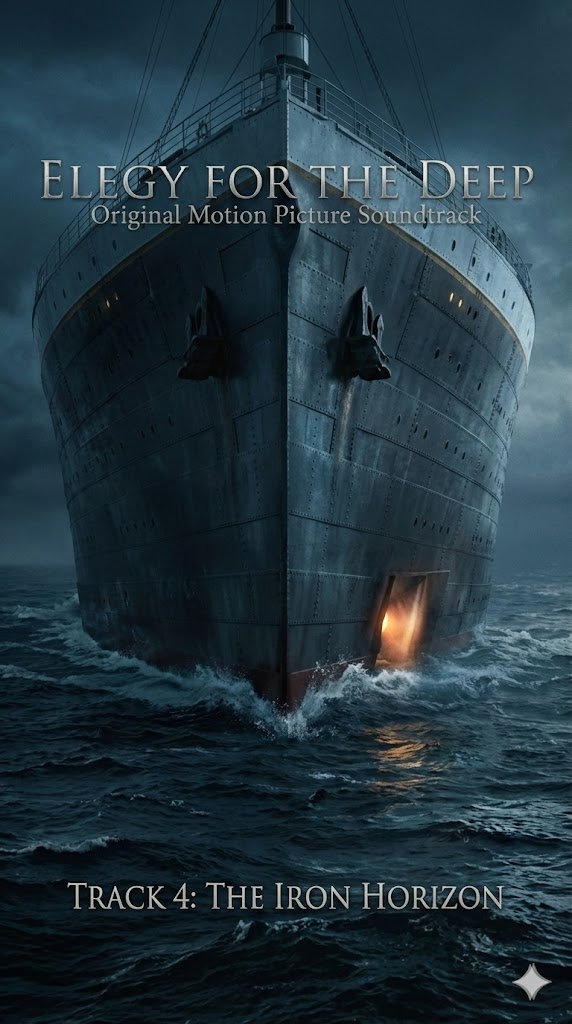
The Iron Horizon - Elegy for the Deep / Track 4

The tone shifts. The lingering beauty of the midnight sea dims, replaced by a subtle but unmistakable heaviness. Track 4 begins with a low, slow pulse, a tectonic hum that seems to vibrate through the depths themselves. It is not yet danger, not yet terror, but the first whisper of a fate beginning to take shape. We open on the ship’s engine room, massive and cathedral-like, lit by the orange flicker of coal-fired furnaces. Pistons rise and fall with relentless rhythm, steam hisses through narrow valves, and the floor trembles with the immense force driving the vessel forward. The camera pans across the machinery, capturing the hypnotic movement of gears, belts, and hammering rods. It's a symphony of motion, iron performing a muscular ballet. Men shovel coal with practiced precision, their faces streaked with heat and soot. Sweat glistens in the firelight. Above, the conductor of this mechanical orchestra, Chief Engineer Hargrove, watches the gauges with a stern but attentive gaze. His presence is calm and authoritative. He taps a brass dial lightly with the back of his knuckle, checking the pressure. Satisfied, he nods to his crew, who continue their work without pause. Then, without dramatic flourish, the music introduces its central motif, a low, four-note brass statement, like a warning spoken by the ship itself. The score rumbles beneath the dialogue of metal, and suddenly the engine room feels less like a triumph of engineering and more like a creature straining against something unseen. Cut to the ship’s bridge. Officers confer quietly. Charts lie open under lamplight, compass needles twitching ever so slightly. The air is crisp, the windows fogged at the edges. The ship moves faster now, encouraged by the calmness of the water. The captain steps to the forward window. Through the glass, nothing exists but the void of night. Outside, the ocean looks darker than before. Moonlight skims only the surface, unable to reveal the full emptiness beneath. The camera glides forward until the ship’s bow looms over the lens, carving through the water with subtle violence. We shift to Elara. She has returned to her cabin, still unsettled by the faint glow she saw earlier. She sits at a small wooden desk, journal open, a lantern illuminating her thoughtful expression. She tries to write, but her hand hesitates. Instead, she sketches a pattern of vertical lines, the musical equivalent of breath held in tension. Her fingertips hover over the page. Something doesn’t feel right, though the world remains calm. Her cabin window rattles slightly, just a shiver of metal meeting cold air. She looks up, eyes narrowing. The sound is minute, barely noticeable, but it carries the same unease that has been growing inside her. She rises, crossing to the window to peer out into the night. Nothing. Only the endless darkness and the whisper of wind. The film transitions to a corridor deep within the ship, where the ship’s hull groans softly. Metal bends imperceptibly under pressure and temperature. These sounds aren’t dangerous yet, but they foreshadow an approaching shift. A lone crewman walks the hallway, lantern in hand. His footsteps echo against steel walls. As he passes a junction, the camera holds on the intersection for a moment. The faintest resonant rumble travels through the frame, like a muted heartbeat. A vibration. Something from far ahead, carried through iron. We cut to the lookout nest, high above the deck. Two lookouts scan the horizon, wrapped in thick coats, breath forming pale clouds. One of them shifts uncomfortably. “You feel that?” he asks quietly. His partner glances at him. “What?” He hesitates. “I don’t know... like we’re pushing into something.” They return to scanning. The hum of wind around the mast intensifies just slightly, blending with the low brass of the score. The sea ahead remains black and featureless, but the lookouts feel a pressure they cannot articulate, a frictionless resistance, as though the night itself has become denser. The camera glides downward to the hull slicing through the water. Bubbles peel away in shimmering streams. Each surge of the ship’s bow seems heavier, more forceful, as if the ocean is beginning to push back. Back in the present timeline, Aurelius stands on the deck of his small vessel. He closes his eyes, listening to the deep rumble of distant waves. His fingers lightly grip the cold railing. It is here that he senses something the way Elara once did, a shift in atmosphere. He whispers: “This is where the night began to turn.” The music deepens. Brass thicken. Strings form tense, low clusters. We return one last time to the engine room, now louder and hotter. The pistons pump with greater force. Coal glows white beneath the shovel blades. The men work faster, driven by the engine’s appetite. And then... the rumble. A subtle change in vibration. The Chief Engineer looks up sharply. A gauge flickers. A pipe shivers. The ship pushes forward into the cold night, unaware that it has crossed an invisible boundary, a point of no return. The scene ends with a slow, foreboding shot of the bow slicing into darkness, accompanied by the brass motif repeating like a distant, unanswered warning. Cut to black. ⌬-----⌬-----⌬-----⌬-----⌬-----⌬-----⌬ [© 2025 ⌬ 𝙲𝚑𝚊𝚍𝚇.𝚊𝚒 ⌬ | This work is protected. No reproduction, redistribution, or commercial use without written consent. Remixing is permitted in Suno using the official “cover” feature, provided proper credit is given to the original artist. Respect the art, respect the artist.] ⌬ ChadX.ai - @ChadwickHalse ⌬
