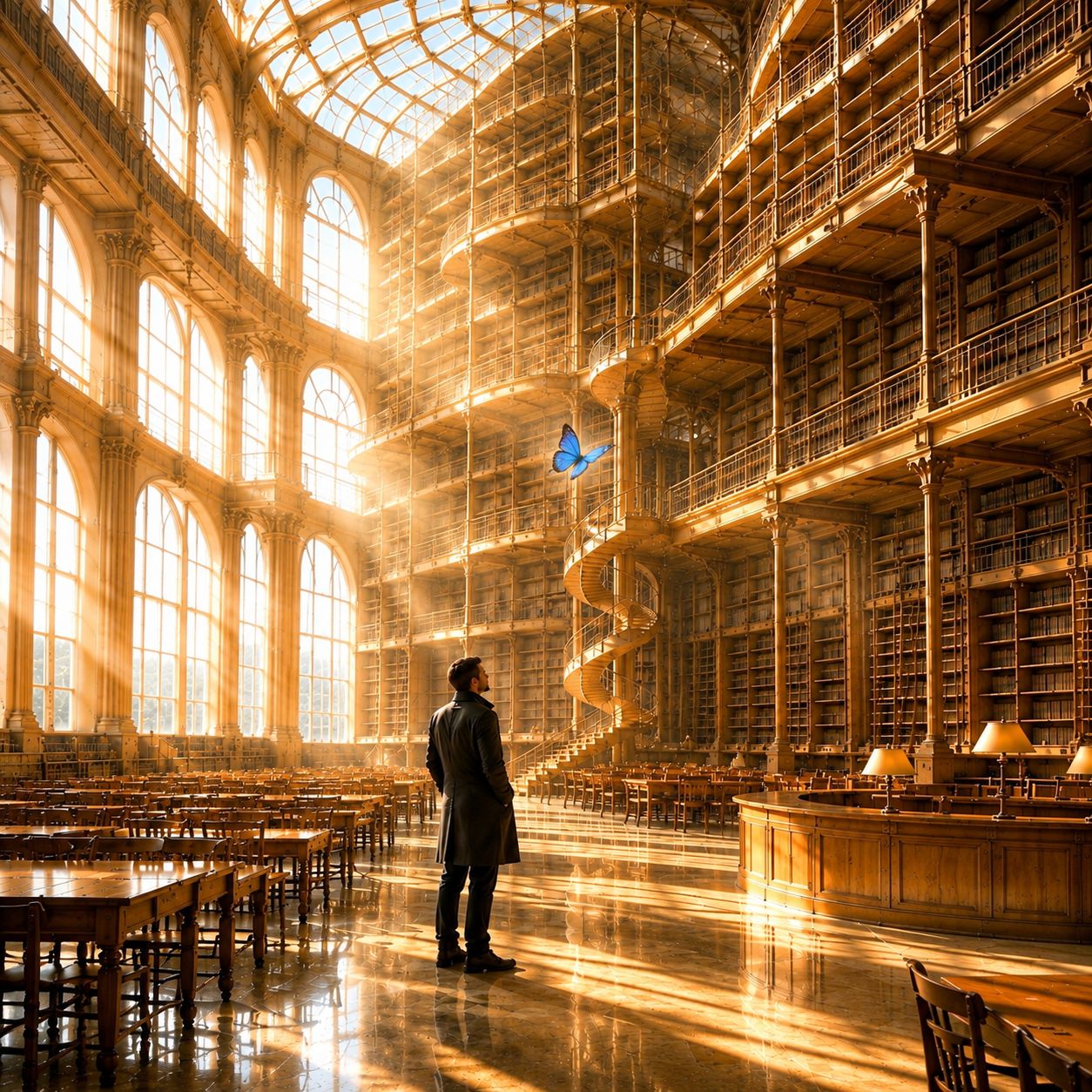

[STYLE: French literary art song, ambient synthwave, nocturnal chamber electronica, downtempo, analog ambient, subtle nu-jazz textures without groove] [MOOD: intimate, mysterious, winter melancholy, empty library, beautiful unease, gradual loss of identity, hypnotic, restrained, never theatrical] [TEMPO: 72 BPM, slow] [INSTRUMENTATION: felt piano as the main structural instrument, Sequential Prophet-6 warm analog pads, Oberheim OB-8 distant ambient textures, very sparse Fender Rhodes Mark I, Moog Sub 37 almost inaudible low sustained tones, Roland RE-201 Space Echo, Strymon BigSky shimmer reverb, subtle 16-track tape saturation] [NO DRUMS at first. No funk groove, no wah-wah guitar, no conventional pop chorus, no horror clichés, no jump scares, no aggressive bass, no dramatic orchestral climax.] [VOICE: adult male French voice, intimate natural baritone/tenor, native French pronunciation, close-miked and almost spoken at first, restrained and emotionally contained] [THE ECHO: always derived from the SAME voice. Never use a stereotypical ghost voice. Begin as natural room resonance, then slight delay, then doubled voice, then independent fragments, then multiple reflections. The echo gradually becomes the author.] [MUSICAL ARC: regularity → fissure → repetition → displacement → vocal multiplication → loss of authorship → silence] [INTRO — almost empty room. Felt piano, very sparse. The room is large but quiet.] Je rentre : pas de livre. Les rayonnages sont vides. La poussière recouvre le bois des étagères ; Quand je murmure un mot, d’une voix étrangère, Le silence patiente, immobile et avide. [The first quatrain is perfectly controlled. Piano phrasing symmetrical and restrained. Almost no echo yet.] [After “avide”, leave a brief silence.] Je parle un peu plus haut. Le mot revient vers moi. Il glisse sur les murs, s’attarde, puis s’efface ; Il revient autrement, sans retrouver sa place, Et quelque part, ma voix continue sans soi. [The voice becomes slightly stronger. The piano motif returns, but one repetition is subtly displaced.] [Very subtle RE-201 delay on fragments of “revient”, “autrement”, “sans soi”.] [The phrase “sans soi” should feel strange and suspended. First true crack in the music.] Je crie. L’écho reprend ce qui fut ma voix. Puis des mots impassibles reviennent en convoi ; Je les entends parler là où je me tais. [“Je crie” is the strongest human vocal moment. Raw, sincere, exposed, never theatrical.] [Immediately after the cry, the echo remains calm.] [The RE-201 now becomes audible. Fragments of the previous voice return from different distances.] [On “en convoi”, introduce several overlapping reflections of the SAME male voice. Not a choir. Not ghosts. A procession of identical voices, each slightly displaced.] [The narrator begins to disappear from the foreground.] [The instrumental texture becomes wider: Oberheim pads slowly open, Prophet-6 remains warm and distant. The music becomes more beautiful while the narrator loses control.] [Leave noticeable spaces between vocal phrases.] Le rayonnage se rapproche sans bruit, [Almost everything drops away. Felt piano and room resonance.] [The physical space seems to move closer. No dramatic sound effect.] Et je vois, au revers du poème, une date : la mienne. [The vocal phrase must overflow the established rhythmic structure. Do not force it into a regular measure.] [The harmony subtly expands beyond the original tonal center. The phrase should feel too long for the musical frame.] [Long silence.] Je me tais. L’écho, sans moi, écrit ce que j’efface. [The narrator becomes almost inaudible.] [The final line begins in the exact same voice, then gradually becomes indistinguishable from its echoes.] [Several very soft fragments of the voice may remain around “sans moi”, “écrit”, “j’efface”.] [No new voice. No horror effect.] [The listener should no longer know whether the final words are spoken by the man, his echo, or the room itself.] [INSTRUMENTATION slowly disappears.] [No final chord. No conventional resolution. No whispered “echo”.] [Let the last resonance decay naturally into silence.] [FINAL FEELING: the poem has continued after its author disappeared. Sonnet au revers du poème
