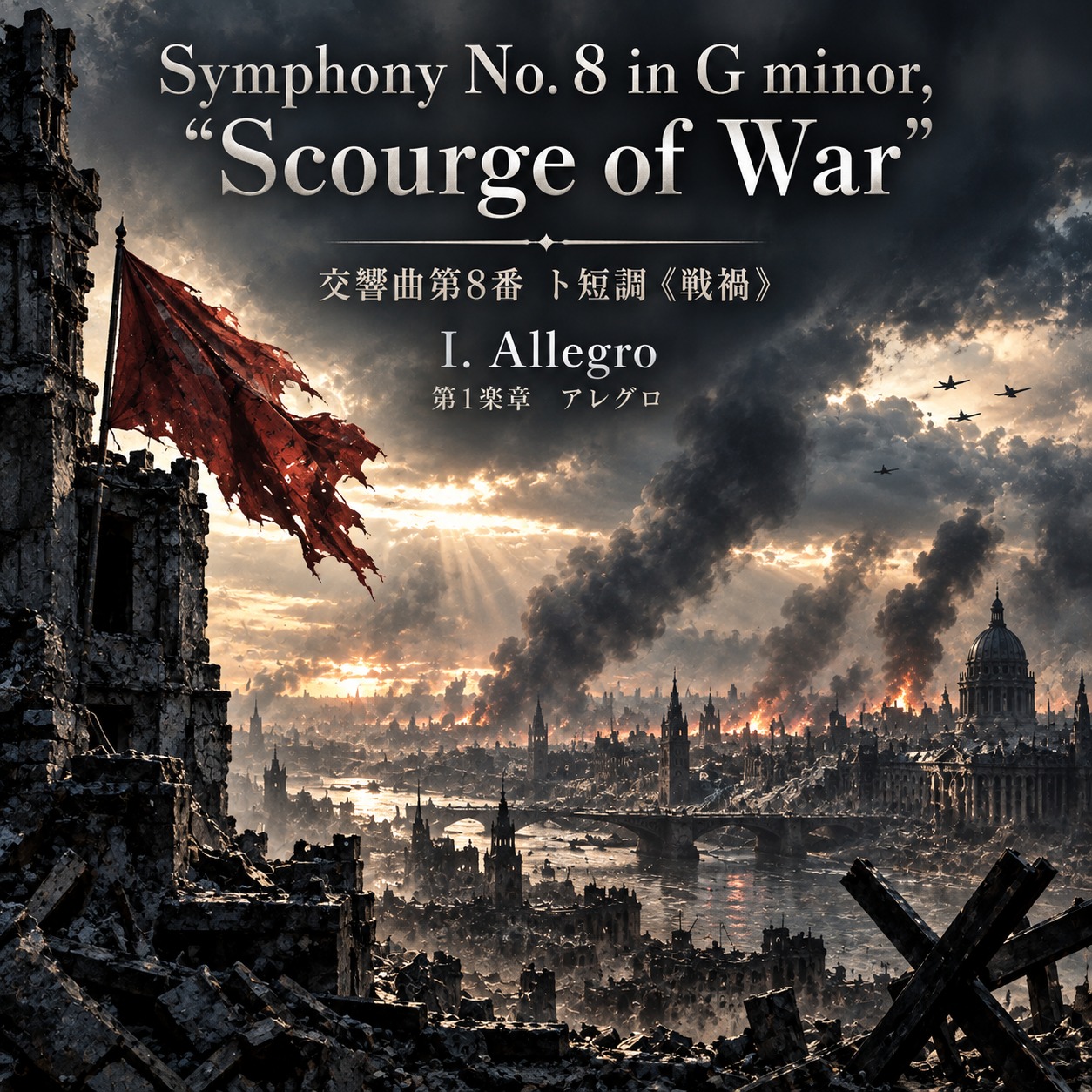

Symphony No. 8 in G minor, “Scourge of War” I. Allegro — G minor II. Vivace — C minor III. Adagio — F minor IV. Allegro con brio — E minor All Movements Playlist here.↓↓↓ https://suno.com/playlist/0fe128d8-ce15-4157-8919-1e9f79616ed4 OVERVIEW A considerable amount of time passed between Symphony No. 7, Dramatica, and Symphony No. 8. After completing the Seventh, I struggled with the question: “Could I create something that would surpass it?” Nevertheless, I continued writing orchestral works, including film-score-inspired projects, a Piano Concerto, and a Trumpet Concerto. The latter was composed almost in parallel with this symphony and uses some motifs from its First Movement. I began serious work on Symphony No. 8 in August 2026. Knowing that Suno would undergo changes in September, and concerned that I might no longer be able to create music in the same way, I began the work using V4.5. The central theme is war. In Japan, August is a time to remember the end of the Second World War and those who lost their lives. As long as wars continue, humanity cannot avoid confronting this subject. Across four movements, the symphony portrays the outbreak and expansion of war, its madness, sacrifice, and aftermath. ■ ABOUT THE SOUND The First, Second, and Fourth Movements were created using V4.5 and remastered with V5. The Third Movement, completed last, was created using V6. I chose V4.5 for its raw orchestral character. Although its audio quality is imperfect, I prefer sharp strings, aggressive brass, and powerful percussion over an overly polished orchestral sound. For the First and Fourth Movements, I particularly imagined the hard-edged, sometimes ferocious sound of the Soviet-era Leningrad Philharmonic Orchestra, now the St. Petersburg Philharmonic Orchestra. Rather than removing this roughness, I made it part of the sound world of Scourge of War. INSTRUMENTATION Flute, Clarinet, Oboe, Bassoon, Horn, Trumpet, Trombone, Tuba, Timpani, 2 Snare Drums (2 players), Bass Drum, Cymbals, Floor Tom, Tambourine, Tam-tam, Harp, Strings I. Allegro The First Movement portrays a war reminiscent of the Second World War, tracing its outbreak and expansion and the gradual engulfment of human lives by forces beyond their control. Its present form was reached only after repeatedly using Suno’s “Extend” function until I was satisfied with its development. Centered on G minor, the music begins with heavy motion in the lower register and violent orchestral outbursts. There is no heroic introduction or promise of victory. Instead, something already seems to have been set in motion, creating a tension that cannot be stopped. Short motifs recur in changing forms while brass and percussion cut into restless string figures. Sudden dynamic surges, brutal accents, and unstable harmonies create an austerity reminiscent of Shostakovich, as forces greater than the individual gradually dominate the music. Yet the movement is not defined solely by this severity. When the violence recedes, broad string melodies reveal a late-Romantic lyricism. The perspective shifts from war itself to the people living within it: memories of ordinary life, thoughts of those left behind, and uncertainty about what lies ahead. Romantic expression emerging from the harsher musical landscape gives the conflict its human dimension. The calm cannot last. Ominous motion returns from the lower register, and earlier motifs spread through the orchestra. The opening material is fragmented, rearranged, and intensified until isolated gestures become an overwhelming orchestral mass—mirroring how conflict can expand until entire societies are consumed by war. Quieter moments return, but the former world cannot be restored. Unstable harmonies and dark undercurrents remain, making the contrast not simply one of “peace” and “war,” but of fleeting ordinary life beneath the constant shadow of conflict. Toward the end, the accumulated tension is unleashed. Fierce string repetitions combine with brass and percussion in an enormous torrent of sound. This is not the exhilaration of glorious battle, but war growing beyond anyone’s control and consuming both individuals and society. The movement closes without complete resolution. The darkness of G minor remains, offering no clear salvation. Everything heard so far has represented only the beginning of the war. Shostakovich-like severity and austere orchestral writing coexist with long Romantic melodies and human lyricism. Through their collision, the First Movement portrays both war and the people forced to live within it. Where this war will ultimately lead is a question left unanswered until the Fourth Movement. ーーーーーーーーーーーーーーーーーーーーーー 交響曲 第8番 ト短調《戦禍》 Symphony No. 8 in G minor, “Scourge of War ーーーーーーーーーーーーーーーーーーーーーー 第1楽章:Allegro — ト短調 I. Allegro — G minor 第2楽章:Vivace — ハ短調 II. Vivace — C minor 第3楽章:Adagio — ヘ短調 III. Adagio — F minor 第4楽章:Allegro con brio — ホ短調 IV. Allegro con brio — E minor ーーーーーーーーーーーーーーーーーーーーーー 【作品概要】 交響曲第7番《ドラマティカ》の完成後、「これ以上の作品を作れるのか」という葛藤から、第8番までには長い時間が空いた。その間も映画音楽風の作品やピアノ協奏曲、トランペット協奏曲など、管弦楽作品の制作は続けていた。特にトランペット協奏曲は本作とほぼ並行して制作しており、第8番第1楽章のモティーフも一部使用している。 本格的な制作を始めたのは2026年8月。9月からSunoの仕様が変わることを知り、これまでと同じ制作ができなくなる可能性を考え、V4.5で制作を開始した。 本作のテーマは**「戦争」**。日本にとって8月は第二次世界大戦の終結と犠牲者を振り返る時期でもある。戦争が起こり続ける限り、人間が避けて通ることのできない問題として、本作では戦争の始まりと拡大、その狂気、犠牲、そして戦争が残すものを4つの楽章で描いている。 ■ サウンドについて 第1・第2・第4楽章はV4.5で制作し、V5でリマスター。最後に完成した第3楽章のみV6を使用している。 V4.5を選んだ理由は、その荒々しく生々しいオーケストラの響きにある。音質そのものは決して良くないが、整いすぎた美しいオーケストラよりも、鋭い弦、荒々しい金管、強烈な打楽器が一つの塊となって迫る音を私は好んでいる。 特に第1楽章と第4楽章でイメージしたのは、旧ソ連時代のレニングラード・フィルハーモニー交響楽団(現:サンクトペテルブルク・フィルハーモニー管弦楽団)のような、硬質で荒々しいオーケストラの響きである。現代的に美しく整えるのではなく、その「粗さ」そのものを《戦禍》を描く音の一部とした。 各楽章の詳細については、それぞれのページに記載している。ご興味を持っていただけたなら、ぜひ4つの楽章を通して聴いていただければ幸いである。 【楽器編成】 フルート、クラリネット、オーボエ、ファゴット、ホルン、トランペット、トロンボーン、チューバ、ティンパニ、スネアドラム(2台、奏者は2人)、バスドラム、シンバル、フロアタム、タンバリン、銅鑼、ハープ、弦5部 ーーーーーーーーーーーーーーーーーーーーーー 第1楽章:Allegro 第1楽章は、第二次世界大戦を思わせる戦争を背景に、その始まりから拡大へと向かう時代の不安と、人間が次第に巨大な力へのみ込まれていく過程を描く。 何度も何度も「Extend」を繰り返し行い、納得いくまでやり続け、今の形となった。 曲はト短調を中心とする暗い響きの中、低音域から生まれる重々しい動きと、管弦楽による鋭い強奏によって音楽は開始される。明確な勝利や英雄を予告するような序奏ではない。何かがすでに動き始め、それを止めることのできない緊張が冒頭から張り詰めている。 短い動機は形を変えながら繰り返され、弦楽器の細かな運動へ金管楽器と打楽器が鋭く介入する。突然膨張する音量、強烈なアクセント、安定を拒むような和声。その書法にはショスタコーヴィチの交響曲にも通じる冷徹さがあり、個人の感情よりもはるかに大きな力が音楽を支配していく。 しかし、この楽章はそうした20世紀的な厳しさだけで作られてはいない。 激しい音楽が退いた後、弦楽器を中心として旋律が大きく息をする場面では、音楽の表情が大きく変化する。長い旋律線、厚みを持って広がる弦の響き、徐々に熱を帯びながら管弦楽全体へ拡大していく音楽には、後期ロマン派へ連なる抒情性が残されている。 そこでは戦争そのものではなく、その時代を生きる人間の側へ視点が移る。 失われる以前の日常、残された人々への思い、そしてこの先に何が起こるのか分からない不安。旋律は感情を押し殺すのではなく、時に大きく歌い上げる。ショスタコーヴィチ的な乾いた厳しさの間からロマン派的な情緒が姿を現すことで、戦争が単なる巨大な音響としてではなく、その中に生きる人間の物語として描かれていく。 しかし、その抒情も長くは続かない。 低音部から再び不穏な運動が現れ、短い動機が各楽器へ伝播していく。静かな部分でわずかに開かれていた空間は徐々に狭められ、弦楽器の反復、金管楽器の強奏、打楽器の衝撃が再び音楽を覆い始める。 ここからの発展では、冒頭の素材をそのまま繰り返すのではなく、断片化し、組み替え、密度を高めながら巨大化させていく。小さな出来事として始まったものが連鎖し、やがて国家や社会全体を巻き込む戦争へ変貌していくように、管弦楽も次第に個々の声を失い、一つの巨大な音響へ集約されていく。 それでも、激しい部分の合間には再び静寂が訪れる。 だが冒頭以前の世界へ戻ることはない。静かな音楽の内部にも低音の不穏な動きや不安定な和声が残り、次の爆発を予告し続ける。静寂と強奏の対比は単純な「平和と戦争」ではなく、戦時下に存在する束の間の日常と、その背後から決して消えることのない戦争の影を並置している。 終盤、それまで抑制されていた力が一気に解放される。 弦楽器の激しい反復に金管楽器と打楽器が重なり、冒頭から蓄積されてきた断片が巨大な奔流となって押し寄せる。ここにあるのは華々しい戦闘の興奮ではない。戦争がもはや誰にも制御できない規模へ達し、人間も社会もその流れにのみ込まれていく姿である。 そして楽章は、その緊張を完全には解消しない。 ト短調を中心として築かれてきた暗い世界は最後まで残され、明確な救済を提示することなく第1楽章を閉じる。これは物語の終わりではない。むしろ、ここまで描かれてきたものが戦争の「始まり」にすぎなかったことを告げる終結である。 ショスタコーヴィチを思わせる鋭いリズムと冷徹な管弦楽法。その内部に息づく、ロマン派から受け継がれた長い旋律と人間的な抒情。 二つの異なる音楽的性格が衝突することで、第1楽章では「戦争」と「その中で生きる人間」が同時に描かれる。そして、その戦争が最終的にどこへ行き着くのか――その答えが、第4楽章へと残されている。

0/500