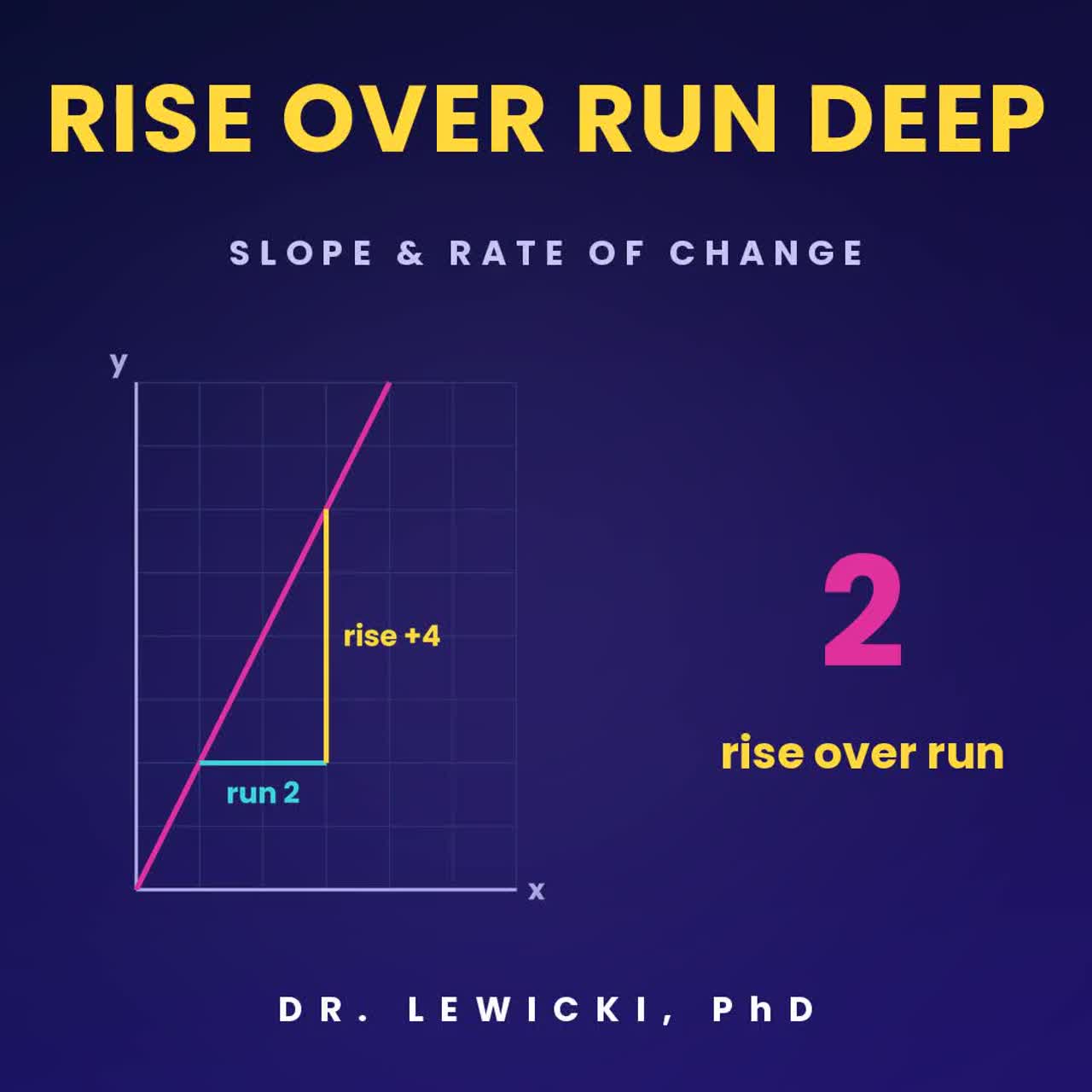

[Intro: 4 bars, piano and bass] Pencils up. How steep, and which way? Rise over run deep. [Hook 1] Rise over run deep! (Rise over run!) Change in y? (On the top!) Change in x? (On the bottom!) Uphill, left to right? (Positive!) Downhill, left to right? (Negative!) Flat line? (Zero slope!) Straight up and down? (Undefined!) Rise, then run. (Now you know!) [Verse 1] Slope — how steep a line is, and which way it's headed, Read it left to right, like a sentence. Rise — the vertical change — up is positive, down is negative, Run — the horizontal change — moving right is positive. Slope is rise over run — change in y over change in x, The change in y on top, the change in x on the bottom. From a graph: pick two points where the line hits grid corners, Count the rise, count the run, then divide. Start on a point — up four, right two — four over two — slope two: Every one step right, the line climbs two. Any two points on that line give the same slope — A straight line keeps one slope all the way. [Hook 2] Rise over run deep! (Rise over run!) Change in y? (On the top!) Change in x? (On the bottom!) Uphill, left to right? (Positive!) Downhill, left to right? (Negative!) Flat line? (Zero slope!) Straight up and down? (Undefined!) Rise, then run. (Now you know!) [Verse 2] Four kinds of slope — four ways a line can go. Positive slope — uphill, left to right — the rise and run both positive. Negative slope — downhill — down three, right one — negative three. Zero slope — a horizontal line, flat — the rise is zero, Zero over any run is zero — y equals four — flat — slope zero. Undefined slope — a vertical line, straight up and down — the run is zero, Rise over zero — you can't divide by zero — undefined. x equals two — vertical — undefined, not zero. Steeper line? Bigger absolute value — slope three is steeper than one-half, Negative five is steeper than negative two — the sign just tells the direction. Slope is a rate of change — how much y changes each time x goes up one. [Hook 3] Rise over run deep! (Rise over run!) Change in y? (On the top!) Change in x? (On the bottom!) Uphill, left to right? (Positive!) Downhill, left to right? (Negative!) Flat line? (Zero slope!) Straight up and down? (Undefined!) Rise, then run. (Now you know!) [Instrumental Break] [Beat switch] [Verse 3] Worked example: two points — no graph needed. Point one: x two, y three. Point two: x six, y eleven. Slope is y two minus y one, over x two minus x one. Change in y: eleven minus three — eight. Change in x: six minus two — four. Eight over four — slope two. Flip the order? Three minus eleven, negative eight, Two minus six, negative four — negative eight over negative four — still two. Same order on top and bottom — that's the rule. Now a downhill one: x one, y seven, to x four, y negative two. Change in y: negative two minus seven — negative nine. Change in x: four minus one — three. Negative nine over three — slope negative three. Downhill. [Breakdown] Up six, right three? (Two!) Down four, right two? (Negative two!) Up one, right four? (One-fourth!) Change in y fifteen, change in x five? (Three!) Horizontal line? (Zero!) Vertical line? (Undefined!) What goes on top? (Change in y!) What goes on the bottom? (Change in x!) [Verse 4] From a table: hours worked, dollars earned — Two hours, thirty dollars — four hours, sixty — six hours, ninety. Each step: dollars up thirty, hours up two — Thirty over two — fifteen dollars per hour. Divide by the x step — it's not always one. That slope's a rate of change — fifteen dollars every hour. A car drives steady — a hundred eighty miles in three hours — One eighty over three — sixty miles per hour — the slope of its distance-time graph. A phone at ninety percent drops to thirty in four hours — Negative sixty over four — negative fifteen percent per hour — a negative rate. Common mistakes: run over rise is upside down — y goes on top. Same order, top and bottom — mix the order and the sign flips — wrong. Horizontal is zero, vertical's undefined — don't swap them. Read left to right — downhill is negative, uphill is positive. [Hook 4] Rise over run deep! (Rise over run!) Change in y? (On the top!) Change in x? (On the bottom!) Uphill, left to right? (Positive!) Downhill, left to right? (Negative!) Flat line? (Zero slope!) Straight up and down? (Undefined!) Rise, then run. (Now you know!) [Hook 5] Rise over run deep! (Rise over run!) Change in y? (On the top!) Change in x? (On the bottom!) Uphill, left to right? (Positive!) Downhill, left to right? (Negative!) Flat line? (Zero slope!) Straight up and down? (Undefined!) Rise, then run. (Now you know!) [Outro] "A trail climbs from three hundred feet at mile two to nine hundred feet at mile five. What's the slope?" Change in y: nine hundred minus three hundred — six hundred. Change in x: five minus two — three. Six hundred over three — two hundred feet per mile. Rise over run deep. Class dismissed. [Instrumental Outro]
