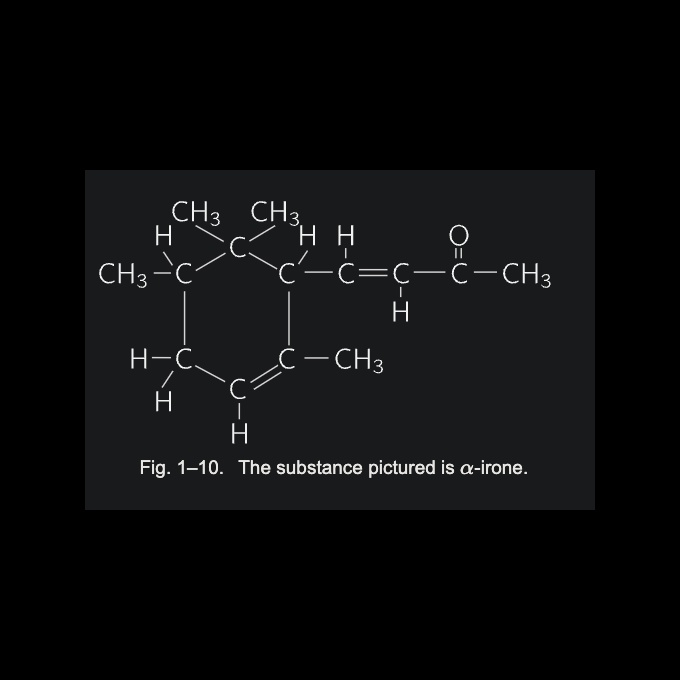

How does the chemist find what the arrangement is? He mixes bottles full of stuff together, and if it turns red, it tells him that it consists of one hydrogen and two carbons tied on here; if it turns blue, on the other hand, that is not the way it is at all. This is one of the most fantastic pieces of detective work that has ever been done—organic chemistry. To discover the arrangement of the atoms in these enormously complicated arrays the chemist looks at what happens when he mixes two different substances together. The physicist could never quite believe that the chemist knew what he was talking about when he described the arrangement of the atoms. For about twenty years it has been possible, in some cases, to look at such molecules by a physical method, and it has been possible to locate every atom, not by looking at colors, but by measuring where they are. And lo and behold!, the chemists are almost always correct. It turns out, in fact, that in the odor of violets there are three slightly different molecules, which differ only in the arrangement of the hydrogen atoms. One problem of chemistry is to name a substance, so that we will know what it is. Find a name for this shape! Not only must the name tell the shape, but it must also tell that here is an oxygen atom, there a hydrogen—exactly what and where each atom is. So we can appreciate that the chemical names must be complex in order to be complete. You see that the name of this thing in the more complete form that will tell you the structure of it is 4--3-buten-2-one, and that tells you that this is the arrangement. We can appreciate the difficulties that the chemists have, and also appreciate the reason for such long names. It is not that they wish to be obscure, but they have an extremely difficult problem in trying to describe the molecules in words! How do we know that there are atoms? By one of the tricks mentioned earlier: we make the hypothesis that there are atoms, and one after the other results come out the way we predict, as they ought to if things are made of atoms. There is also somewhat more direct evidence, a good example of which is the following: The atoms are so small that you cannot see them with a light microscope—in fact, not even with an electron microscope. Now if the atoms are always in motion, say in water, and we put a big ball of something in the water, a ball much bigger than the atoms, the ball will jiggle around—much as in a push ball game, where a great big ball is pushed around by a lot of people. The people are pushing in various directions, and the ball moves around the field in an irregular fashion. So, in the same way, the “large ball” will move because of the inequalities of the collisions on one side to the other, from one moment to the next. Therefore, if we look at very tiny particles in water through an excellent microscope, we see a perpetual jiggling of the particles, which is the result of the bombardment of the atoms. This is called the Brownian motion.
