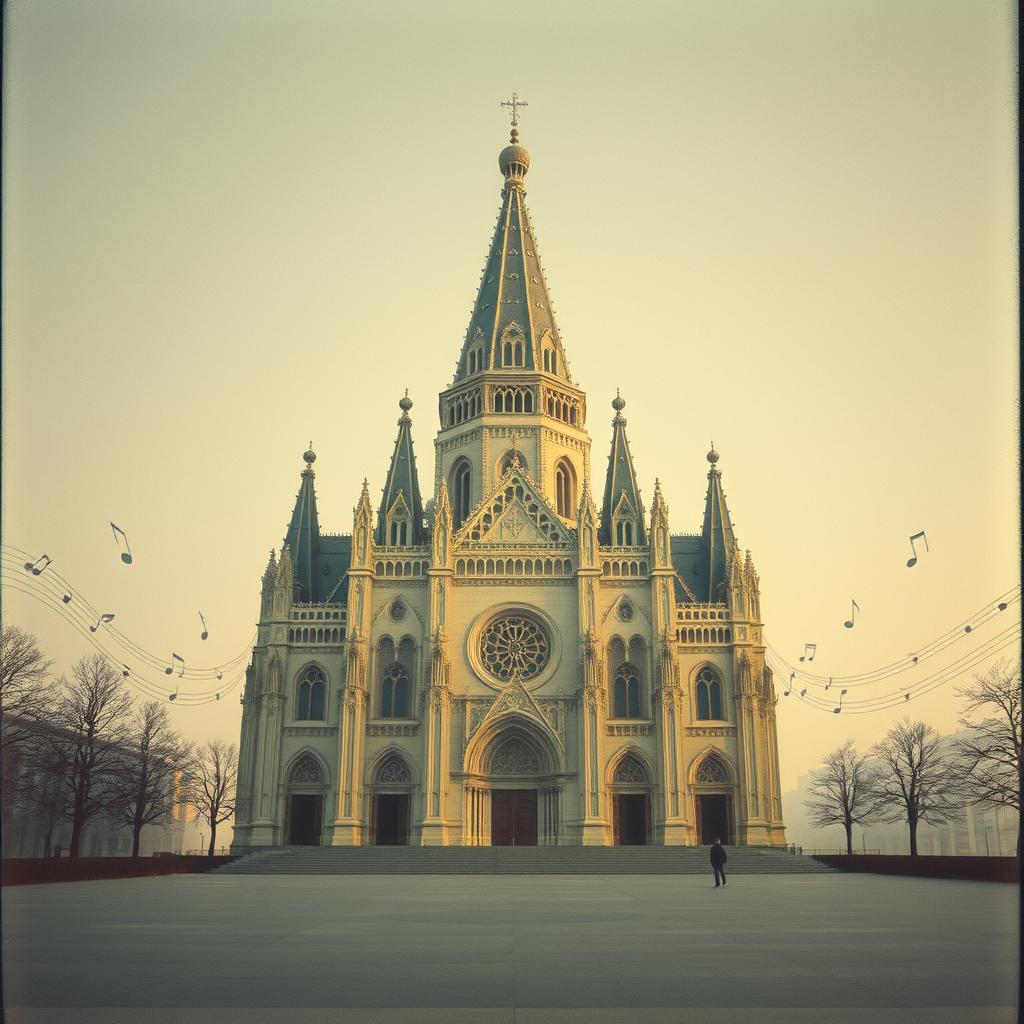
The cathedral outside of time
I was in Tournai in nineteen ninety, And I had the chance to visit The three houses from the Romanesque period still standing. Usually, Romanesque buildings in northern Europe Did not survive more than a human lifetime; After seventy years, they collapsed. This is why Romanesque houses Were so rare to find. But the houses from twelve to fourteen Barre Saint-Brice Street, Made of stone and solidly built, Were still standing in nineteen eighty-nine to nineteen ninety. They were then serving as a Protestant church, And it was there that I was put in contact With a Canadian researcher. She told me she was working On the dossier of a bishop of Tournai in the medieval period, And that she came from Toronto. Trying to find out which university she was affiliated with — The Centre for Medieval Studies at the University of Toronto, Faculty of Arts and Science, Department of History, History and Visual Culture at York, Or Ryerson — Was like searching for a needle in a haystack. It is also possible that she was A doctoral student associated with McGill or the University of Ottawa, Collaborating with a Toronto university On a mission in Belgium. It was thanks to her that I had the joy Of visiting these places. Then I turned to the cathedral of Tournai, A marvel of the city, Built on a site occupied since the Merovingian period, Where the first tombs attest To the long continuity of settlement and worship. Its Romanesque central nave, Supported by four side aisles, Was mainly built between eleven fifty and twelve hundred In local limestone. It inspired respect through its austere simplicity, In its series of round arches Overlooking the side aisles. Its Gothic choir, added later, Between twelve thirty and twelve fifty, Is of the early Gothic style, Like a sky opened by elevation. The cathedral has five towers, Including the famous central Romanesque tower, seventy-two meters high, Set at the crossing of the nave and transepts, Bravely flanked by four lower corner towers. The cathedral’s treasure includes The Flemish Shrine of Our Lady, A silver and enamel reliquary from the thirteenth century, Renowned for the finesse of its decorations And the richness of its gilding, As well as the relic of Saint Thomas Becket, Martyr bishop of Canterbury, Offered or acquired in the Middle Ages by the canons. I had in mind the vivid lines Of T.S. Eliot in Murder in the Cathedral When he evokes the saint’s mouth. Several twelfth-century carved capitals In the nave depict biblical scenes And vegetal motifs. For this richness and the exceptionality of its architecture, Combining Romanesque and Gothic, The cathedral is listed as a UNESCO World Heritage Site. One can feel the primal work of the encounter Between Romanesque architecture And its Gothic modernization, The fruit of scholastic thought And the effort of the monks of the early Gothic art, Of whom Suger of Saint-Denis was a fervent promoter in his abbey. I remember listening to the Mass of Tournai, Including polyphonic movements for three voices Of an ancestral flavor, dated to the fourteenth century, Gathered in manuscript twenty-seven of the cathedral library. The authors are unknown: Six meditative and cosmic movements — Kyrie, Gloria, Credo, Sanctus, Agnus Dei, Ite missa est. The Kyrie, the Sanctus, and the Agnus Dei Are written in Franconian measured notation, Showing analogies with polyphonic conduits. The Gloria and the Credo Are composed in the Ars nova style, With the Gloria featuring a highly developed Amen. The last movement follows the pluritextual motet style, Where each voice delivers a different text, Isorhythmic, similar to the manuscripts of Montpellier. Thus is revealed the great soul of Tournai, Built on centuries of faith, art, and memory, From the Merovingian necropolis, where the spirits of the early monarchy linger, To the Romanesque and Gothic marvels, Still alive in stone and polyphony. I always take great pleasure In listening to the two Harmonia Mundi recordings of this mass: By the Ensemble of Early Music of Barcelona, directed by Enric Gispert, And the Ensemble Organum of Marcel Pérès. It is like renewing oneself while solemnly traversing time and space.
