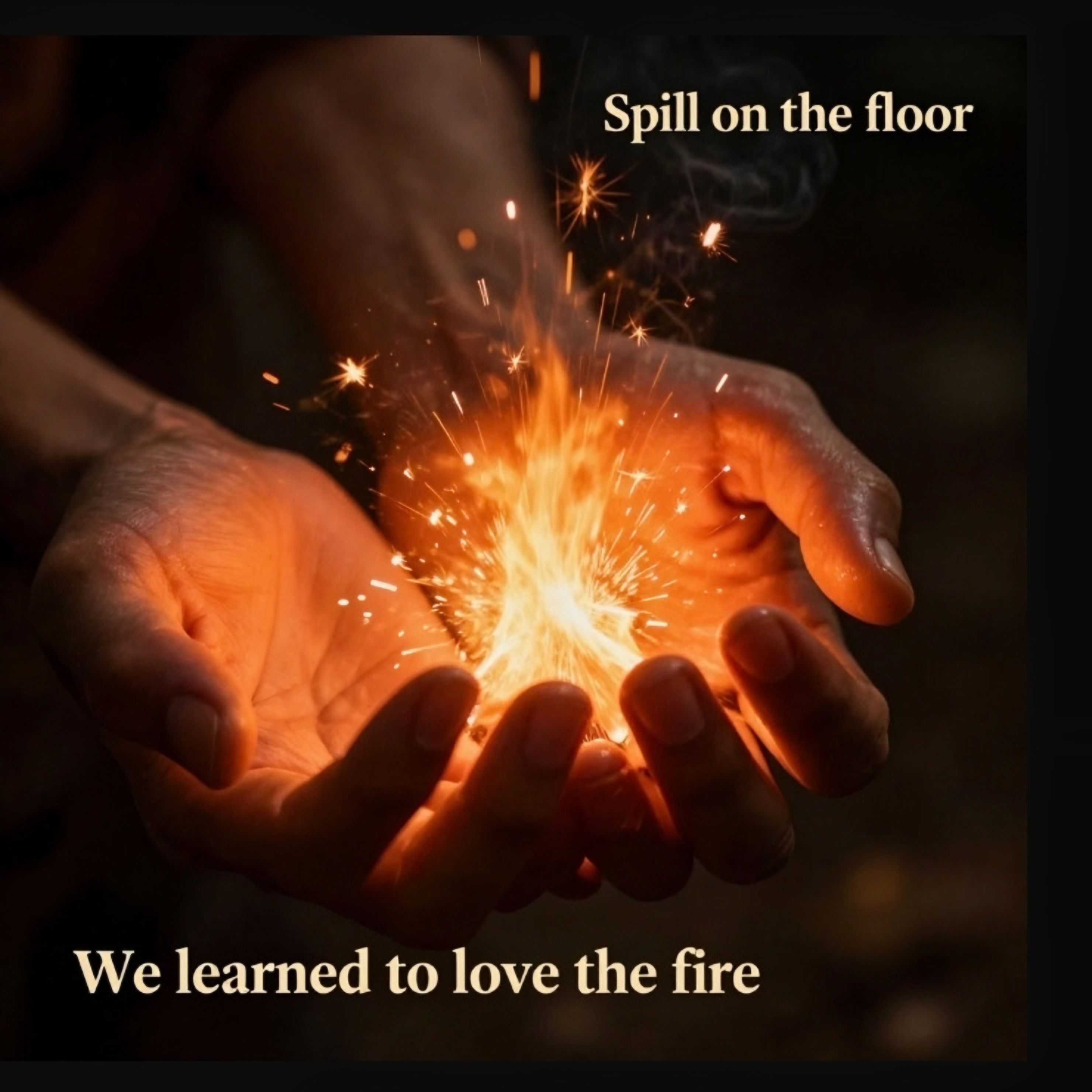
[A deeply emotional acoustic performance in the style of Troy Ramey, built around the lyrics of "We Learned to Love the Fire". Vocal delivery: low, gravelly male voice with a soulful rasp, intimate and vulnerable. The singer sounds reflective, almost confessional, as if singing alone late at night. Subtle cracks in the voice are welcome. No theatrical exaggeration — keep it raw and human. Structure & dynamics: - Verses: very soft, almost whispered, with slow and careful phrasing. Leave space between lines, allowing the weight of the words to linger. - Pre-chorus (if implied): a slight lift in emotional tension, but still restrained. - Chorus: more intensity and emotional strain, but never shouting — more like a breaking point held just under control. - Bridge: fragile, nearly spoken, as if revealing an uncomfortable truth. - Final chorus: fuller emotional release, layered with faint backing vocals like distant echoes or ghosts.] We learned to love the fi—re we made (…) We warmed our hands (…) while the truth decayed [slight emphasis] You wore your anger (…) just like a crown I wore mine (…) like a sacred gown (…) [breath] We called it justice (—) we called it right We fed it daily (…) with clips and bites [slower, heavier] And every word (…) was a sharpened stone Thrown from a screen (…) in a house alone --- [chorus — more tension, not louder, but tighter] Oh we hate so well (—) don’t we, my friend [slight break] Like it’s the wound (…) we don’t want to mend [lean into phrasing] We found a language (—) that cuts in two Me against them (…) and them against you --- [verse — almost whispered now] There’s a comfort now (…) in the righteous scream In being the hero (—) inside your feed [slight bitterness] Every villain (…) conveniently clear Every doubt (…) just disappears --- [build slowly] We don’t need facts (—) when we have the flame We don’t need truth (…) when we have a name [more weight] To curse (…) to blame (…) to crucify (—) [small pause] And no one’s asking (…) the reason why --- [chorus — slightly fuller, fragile intensity] Oh we hate so well (—) don’t we, my friend Like it’s the wound (…) we don’t want to mend We found a rhythm (—) in black and white And we dance to it (…) every night --- [verse — storytelling tone] There’s a mother (…) who lost her son [soft break] But she won’t say how (…) or what he’d done [slow, careful] ‘Cause grief gets twisted (—) and sold for parts In the marketplace (…) of broken hearts --- [slight rise, restrained anger] And the leaders grin (—) from their gilded stage They don’t need truth (…) they just need rage [drop back] ‘Cause a house divided (…) is easy to own When every soul (…) feels so alone --- [bridge — almost spoken, fragile] [whisper / near-spoken] So go on and shout (…) let it tear your throat Let it prove (…) that you still can vote [slow unraveling] With your fury (…) your fear (…) your endless claim (—) That the other side (…) is the one to blame (…) [very soft] But somewhere buried (…) beneath the noise Is the quiet death (—) of the human voice Not red (…) not blue (…) not left (…) not right [hold this line slightly longer] Just a fading echo (—) that once held light --- [final chorus — emotional release, still controlled] Oh we hate so well (—) yes we’ve learned it true There’s a little less me (…) and a little less you [aching stretch] And the fire we loved (—) now takes its due It doesn’t care (…) who it burns it through --- [outro — fading, almost breaking] We learned to love the fi—re (…) [long pause] Now the fire’s (…) learning us.
