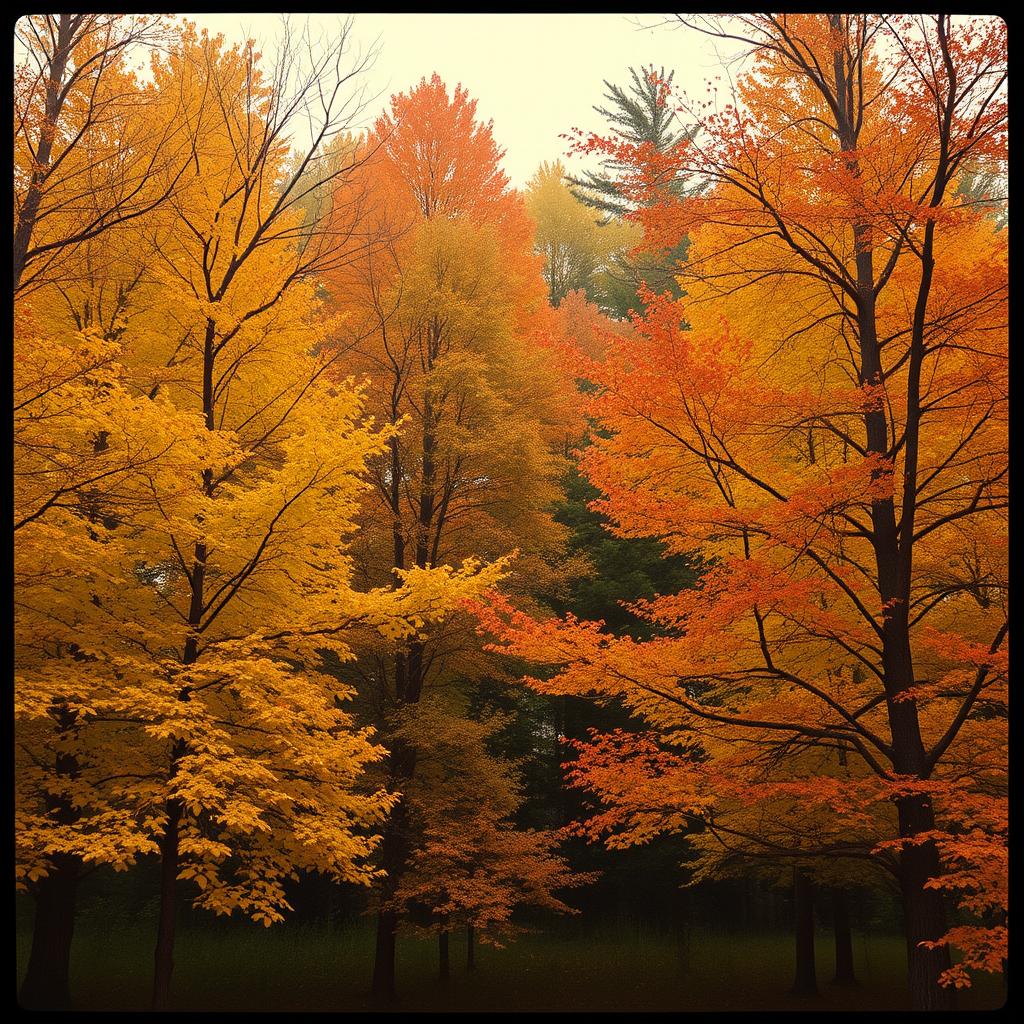
Autumn's Chemistry~The Survival Strategy of Leaf Colour Change
Now, what we're about to explain to you all, is the mechanism of how deciduous trees' leaves change colour in Japan's Autumn season. 【Verse 1】 Autumn deepens, and daylight hours shorten. The minimum temperature drops to eight degrees. Then, the colouration switch is turned on. Between the leaf and the branch, a separation layer is formed. It blocks the transport of water and nutrients. The tree transitions to its winter preparations. 【Verse 2】 The star player of photosynthesis, Chlorophyll, decomposes. It absorbed the red and blue of the sun, and reflected green. Chlorophyll finishes its role. By green Chlorophyll disappearing, a hidden colour becomes visible, that's the mechanism. This is the chemistry of the colour of the tree's leaves. 【Verse 3】 The representative of yellow leaf colouration, is the Ginkgo. It's a gymnosperm yet a deciduous tree, a unique existence. The true identity of yellow is Carotenoid. This yellow or orange pigment, exists in trace amounts throughout the summer. It was hidden by green. 【Chorus 1】 When Chlorophyll decomposes, and the green cover is gone, the yellow Carotenoid that was originally there, appears on the surface. That is the mechanism of yellow leaf colouration. It's very simple, isn't it? 【Verse 4】 In contrast, red leaf colouration is a little difficult. After Autumn comes and the temperature gets low, it starts synthesizing the red and purple pigment, Anthocyanin. The material used is sugar accumulated inside the leaf. Due to the formation of the "separation layer", the flow of nutrients is blocked, and the sugar is trapped inside the leaf. The harsh Autumn sun, UV rays, acts as a catalyst, promoting the chemical reaction, and Anthocyanin is produced. 【Verse 5】 The energy used to perform this synthesis is an investment in life. It can be called a survival strategy for the tree to get through the winter. One reason is the sugar buffer. By consuming the over-accumulated sugar, it maintains the concentration at a safe level. 【Verse 6】 The second reason is nutrient recovery. By undergoing red leaf colouration, it extends the lifespan of the leaf. It efficiently recycles precious elements like Nitrogen, to the branch and trunk. It's buying time. The condition for beautiful red leaf colouration is the difference in day and night temperature. The severity of the night's cold is the key. 【Bridge】 However, due to the impact of global warming, the minimum temperature doesn't drop easily. The colouration front is getting later year by year. The timing is shifting backwards. 【Verse 7】 The urban heat island is the cause in cities. Because the temperature difference is hard to generate, Anthocyanin synthesis is suppressed. The colouration tends to be difficult. Furthermore, the "seasonal chain reaction" has an impact. The high temperatures in Spring are dulling the redness of the red leaf colouration. The period for Anthocyanin synthesis is getting shorter. A sad prediction has been made: the "redness" will decrease by fifteen percent by the end of this century. 【Chorus 2】 That means that this vibrant scenery is gradually being lost, a sad meaning. The beautiful hues are a record of the tree's life. The delay in colouration timing, the decline in colour quality, are reflecting the crisis of life's future. 【Outro】 Let's observe the change in the tree's leaf colour and timing. Nature's grand experiment is currently underway. Perhaps you might make a discovery!
