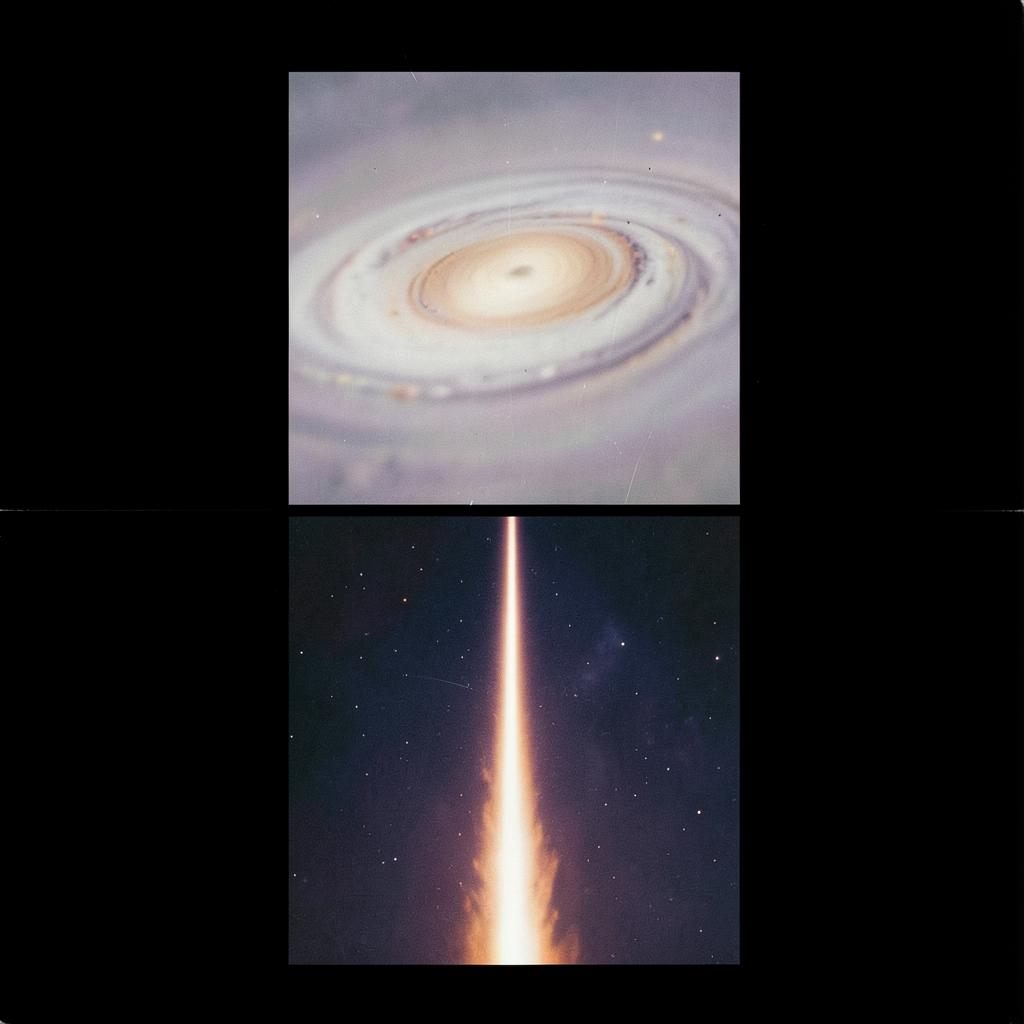

[radio voice, like old radio channel. Male narrator] A quasar is an extremely luminous active galactic nucleus. Sometimes it is also called a quasi-stellar object. It is not a star but the brilliant core of a galaxy, where a supermassive black hole is actively consuming vast amounts of matter. The term “quasar” originated as a contraction of “quasi-stellar [star-like] radio source”. This is because quasars were first identified in the 1950`s as sources of radio-wave emission of unknown physical origin. When observed at visible wavelengths, they appeared as faint, point-like points of light, similar to stars. However, their enormous redshift revealed that they were actually entire galaxies billions of light-years away. The energy of a quasar is powered by accretion onto a supermassive black hole, whose mass ranges from millions to billions of times that of the Sun. The black hole is surrounded by a gaseous accretion disk. As matter spirals inward, it forms a rapidly rotating disk. The inner parts of the disk orbit the black hole faster than the outer parts, creating shear forces that twist the clouds and cause them to collide. This friction generates heat, and the disk becomes extremely hot (millions of degrees) and emits light. In addition to the glowing disk, some of the material in the disk is funneled away from the black hole in the form of highly luminous, magnetically collimated jets of particles being ejected at nearly the speed of light. The combination of the hot accretion disk and the jet makes the nucleus of the active galaxy shine so brightly that it can be seen across the universe. Reinhard Genzel and Andrea Ghez were each awarded a quarter-share in the 2020 Nobel Prize in Physics for their discovery that Sagittarius A is a supermassive compact object, for which a black hole was the only explanation. Sir Roger Penrose received the other half "for the discovery that black hole formation is a robust prediction of the general theory of relativity"
