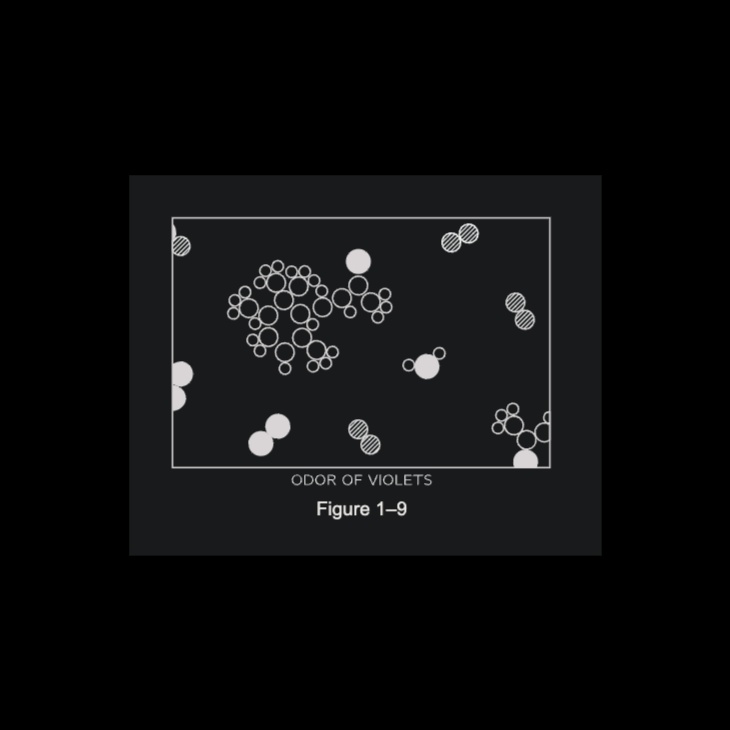

In addition, the carbon monoxide is not quite satisfied. It is possible for it to attach another oxygen, so that we might have a much more complicated reaction in which the oxygen is combining with the carbon, while at the same time there happens to be a collision with a carbon monoxide molecule. One oxygen atom could attach itself to the CO and ultimately form a molecule, composed of one carbon and two oxygens, which is designated CO2 and called carbon dioxide. If we burn the carbon with very little oxygen in a very rapid reaction a considerable amount of carbon monoxide is formed. In many such rearrangements, a very large amount of energy is released, forming explosions, flames, etc., depending on the reactions. Chemists have studied these arrangements of the atoms, and found that every substance is some type of arrangement of atoms. To illustrate this idea, let us consider another example. If we go into a field of small violets, we know what “that smell” is. It is some kind of molecule, or arrangement of atoms, that has worked its way into our noses. First of all, how did it work its way in? That is rather easy. If the smell is some kind of molecule in the air, jiggling around and being knocked every which way, it might have accidentally worked its way into the nose. Certainly it has no particular desire to get into our nose. It is merely one helpless part of a jostling crowd of molecules, and in its aimless wanderings this particular chunk of matter happens to find itself in the nose. Now chemists can take special molecules like the odor of violets, and analyze them and tell us the exact arrangement of the atoms in space. We know that the carbon dioxide molecule is straight and symmetrical: O—C—O. However, even for the vastly more complicated arrangements of atoms that there are in chemistry, one can, by a long, remarkable process of detective work, find the arrangements of the atoms. Figure 1–9 is a picture of the air in the neighborhood of a violet; again we find nitrogen and oxygen in the air, and water vapor. However, we also see a “monster” composed of carbon atoms, hydrogen atoms, and oxygen atoms, which have picked a certain particular pattern in which to be arranged. It is a much more complicated arrangement than that of carbon dioxide; in fact, it is an enormously complicated arrangement. Unfortunately, we cannot picture all that is really known about it chemically, because the precise arrangement of all the atoms is actually known in three dimensions, while our picture is in only two dimensions. The six carbons which form a ring do not form a flat ring, but a kind of “puckered” ring. All of the angles and distances are known. So a chemical formula is merely a picture of such a molecule. When the chemist writes such a thing on the blackboard, he is trying to “draw,” roughly speaking, in two dimensions. For example, we see a “ring” of six carbons, and a “chain” of carbons hanging on the end, with an oxygen second from the end, three hydrogens tied to that carbon, two carbons and three hydrogens sticking up here, etc.
