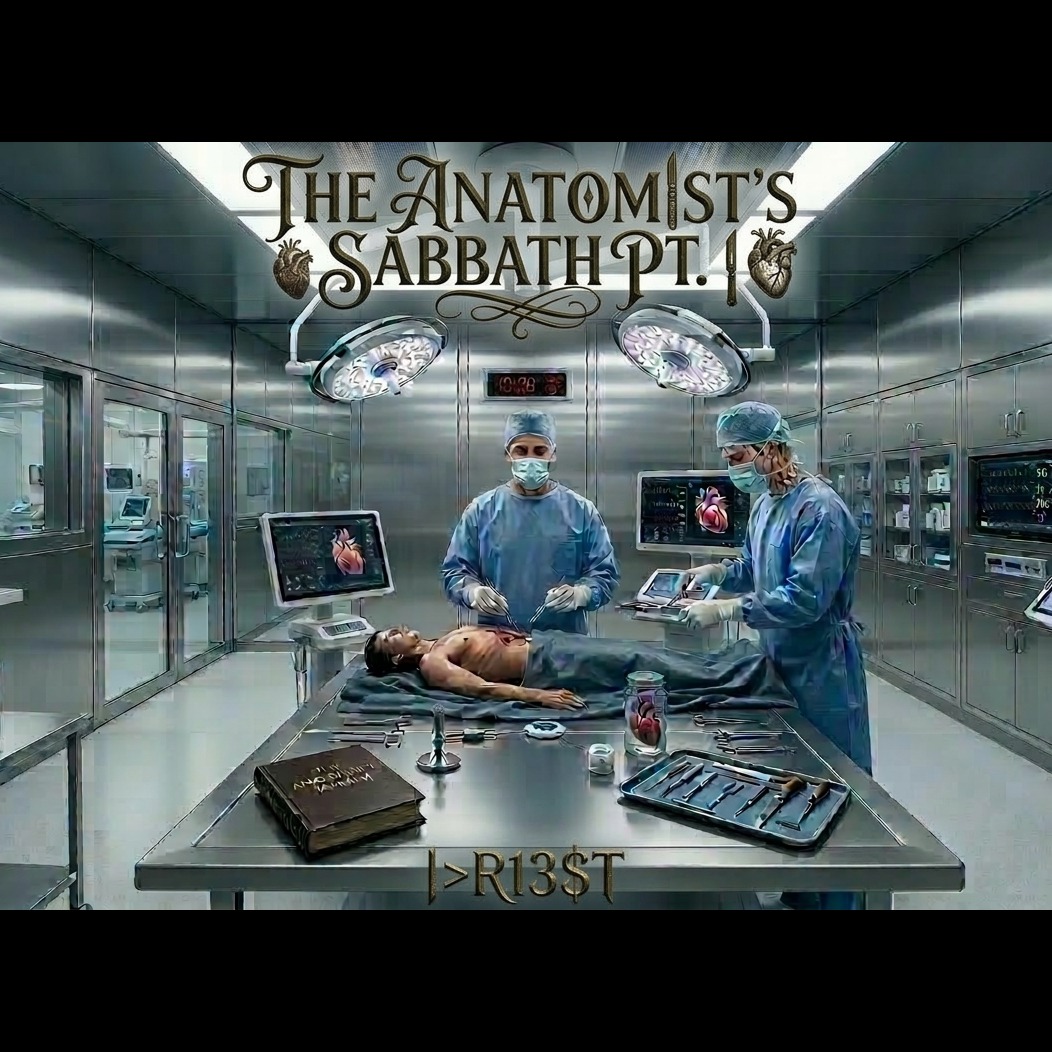
The fluorescent hum of St. Jude’s is a anchor for a god. The silk touch repairs the mitral valve while Debussy plays. But when Oakhaven falls into its humid, midnight slumber, The god in the white coat descends to the sub-basement mausoleum. A theater of glass and brushed steel. A masterpiece of illegal engineering, pressurized and soundproofed. The cold efficiency of a tomb for the structural lust. He does not crave the traditional sins of the flesh. He hungers for the architecture that shouldn't be seen while the heart still beats. The world is merely a warehouse of premium spare parts. A runner’s lungs, a pianist’s carpal tunnels, a linguist’s larynx. He is the only artist qualified to rearrange the canvas. "The tragedy of the human form is its refusal to evolve." "You just need a more creative internal arrangement." The cellist is paralyzed, sensory nerves screamingly wide awake. What is a performance without an audience? A single, bloodless stroke from a custom-forged obsidian scalpel. Peeling back fascia with a reverence that is deeply sickening. Praising the mesenteric artery before clamping it to watch the color change. He is not fixing; he is improving the machine. Rerouting nerves into meaningless loops. Grafting tendons into geometric patterns that serve no biological function. The sun bleeds over the horizon as he stands in the hospital locker room. Clean-shaven, eyes bright, the picture of professional excellence. The cellist is dumped in an alley, physically whole to the untrained eye. But internally, a labyrinth of anatomical horror that would baffle a coroner. A savior taking the blade for the seven a.m. bypass. Hand does not shake as he eyes the intercostal muscles of the sedated. They would look better twisted just a few degrees to the left. The silver needle trembles against the moonlight-washed skin of the cadaver. The ribcage pulses with a rhythmic amber glow. The skin parts like tearing silk, spilling fine metallic dust. Interlocking obsidian gears hum where the heart should have been. "This is no work of God, and yet the craftsmanship is too divine." The cold hand reaches up with the strength of a hydraulic press. Twin voids reflecting a starscape that shouldn't exist in the London fog. "The Sabbath is not for the dead. It is for the architects." The metallic dust coats the surgeon’s skin like microscopic needles. His own flesh takes on a faint, amber luminescence. The specimens in the formaldehyde jars begin to rattle. Eyes in the glass swivel in unison to track the artist's movements. The articulated skeleton tightens its hinges, wire groaning. "We are becoming whole, Doctor." The Sabbath is the gathering of the parts. Thorne lunges for the iron ring behind the mahogany cabinet. A dizzying slide through soot and damp stone to the floor of freezing metal. A cathedral of clockwork. A miniature London on a circular dais. The Thames is a vein of mercury, the buildings carved from bone and brass. Thousands of obsidian gears grinding in an agonizing rotation. The city is a single, massive organism waiting to be wound up. The architecture requires a cornerstone. The city above is about to wake up. Thorne remains. The artist is part of the work now.
