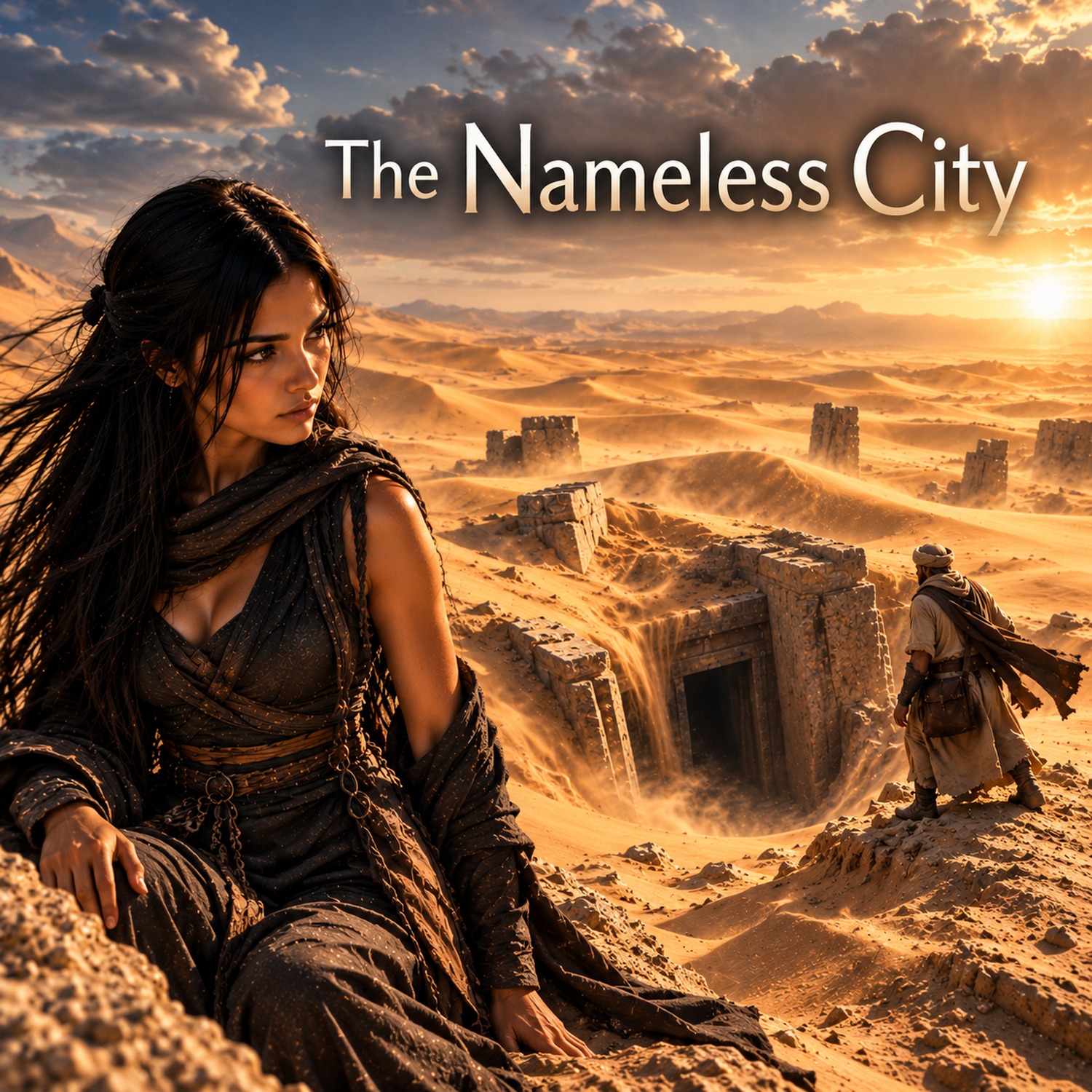

Arabia, early eighth century. At the edge of the desert, Abdul Alhazred found the ruins of a city without a name. The sand had hidden almost everything. Almost. I knew this place before he knew what he had found. No road had led him here. No living voice had called his name. Still the entrance waited open, cut in stone beneath the sand. He stood above it in the sunlight, while the desert moved around him. Then he stepped below the surface, and the daylight followed less and less. Go down. Where the walls forget the sky, where the doors were made for bodies that were never shaped like mine. Go down. Let the upper world grow small. You have found the buried entrance. You have not found the city at all. The passage narrowed as he followed. Stone pressed closer on each side. Ancient images lined the darkness, small forms moving row by row. Doorways opened near the floorline, far too low for him to stand. Every measure of the structure felt designed for something else. Then the flame leaned toward the darkness. No window. No open door. Only air that moved from somewhere far beneath the buried floor. Go down. Where the walls forget the sky, where the doors were made for bodies that were never shaped like mine. Go down. Let the upper world grow small. You have found the buried entrance. You have not found the city at all. He thought the ruins had been abandoned. He was wrong. Abandoned places do not breathe. And somewhere under stone and sand, the darkness drew the flame toward itself. Lower. The stair continued lower. The ceiling pressed closer. The carvings multiplied. And still there was no bottom. Go down. Let the desert disappear. Let the weight of buried centuries close above you while you hear Nothing. Nothing you can name. You came searching for a city. Now the city knows you came. He raised the lamp and took another step. And I remembered what had been waiting there long before I had a name.
