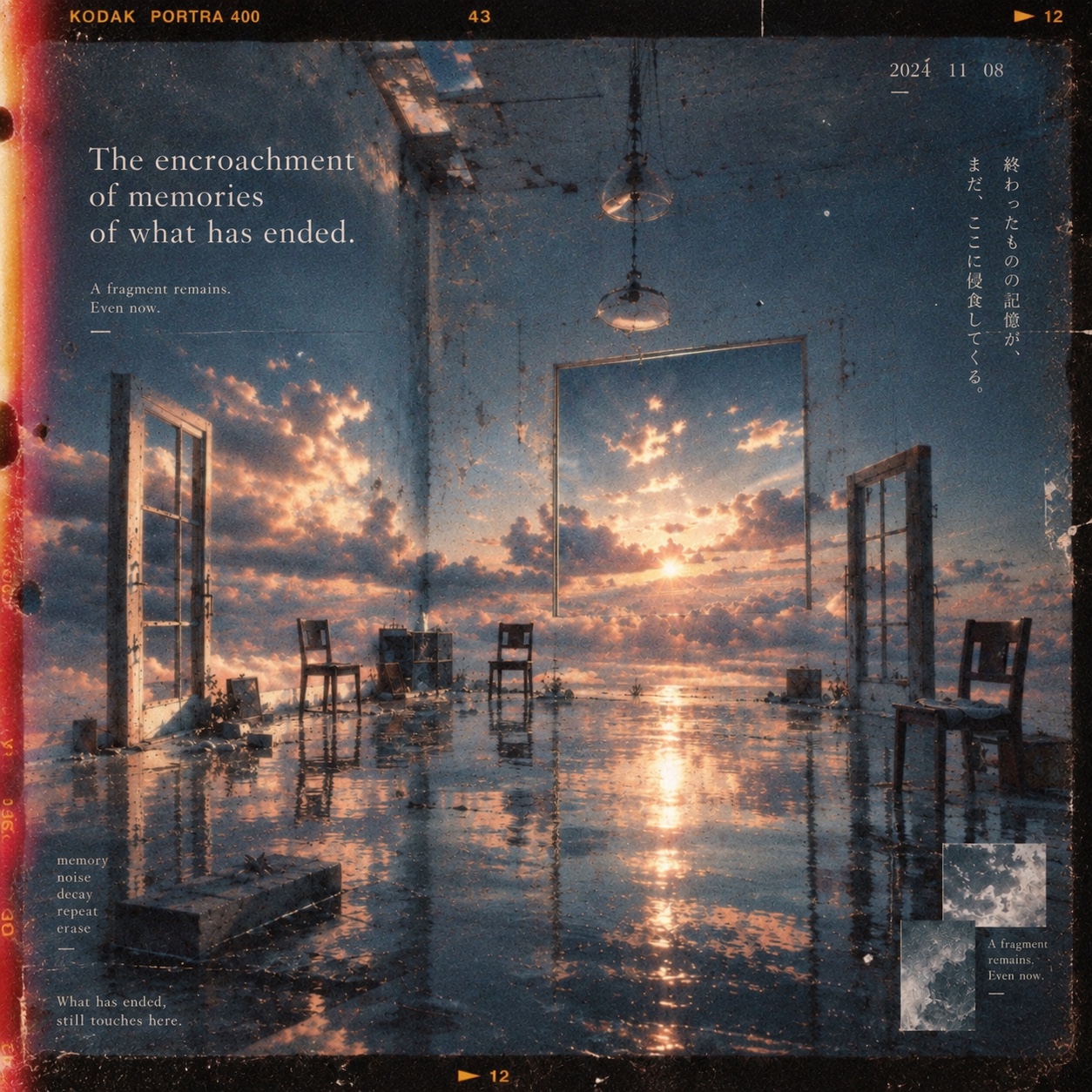
Inst. - The encroachment of memories of what has ended.

[SYNTH SOUND: combine cold early-digital wavetable / virtual-analog atmosphere with FM synthesis.] [Use Virus-like glassy pads for the main atmospheric field: cold, translucent, slightly detuned, wide but thin, slowly moving, with restrained 90s–early-2000s jungle / ambient-DnB character.] [Use DX-style FM synthesis for small crystalline details: glass bells, thin metallic overtones, icy electric-piano-like partials, delicate digital chimes and brief shimmer.] [Do not use huge supersaws or bright modern EDM leads. Synths should feel like light suspended behind the piano rather than foreground hooks.] [VOCAL MIX: all human voice fragments must remain significantly quieter than the piano and drums. Treat voices as distant environmental samples, not lead vocals.] [Keep most vocal samples low in the mix, partially masked by reverb, pads or breakbeats. Avoid centered dry vocals. Place voices behind the instrumental field with reduced high-frequency presence, soft transients and diffused reverb.] [Only very rare vocal fragments may briefly become intelligible. Even then, do not let the voice dominate the mix.] [DYNAMICS: do not maintain constant loudness or constant energy throughout the track.] [Create large-scale dynamic breathing.] [Some sections should become genuinely quiet: piano, faint atmosphere and only a few distant drum fragments.] [Other sections may gradually accumulate break density, sub-bass and atmospheric layers until reaching a dense rhythmic peak.] [After dense sections, remove several layers suddenly or gradually and allow the track to fall back into near-silence.] [Do not solve dynamics only by adding more notes. Change actual perceived loudness, spectral density, stereo width and number of active layers.] [Use clear dynamic contrast between sections: very quiet → restrained → active → dense → sudden collapse → quiet recovery → second rise → final dissolution.] [Allow the drum bus to become more energetic during peaks, but do not use brickwall loudness or aggressive mastering.] [GLOBAL VOCAL RULES] [No conventional lead vocal] [Human voice appears only as sampled fragments] [Keep all voices significantly quieter than the piano] [Voices remain in the background or deep background] [No dry centered foreground vocal] [Reduced vocal presence and softened transients] [Use diffused reverb, filtering and distance] [Partially mask voices behind pads, piano or breakbeats] [Most words should be only partially intelligible] [Only rare isolated phrases may briefly become clear] [Immediately return clear phrases to the background] [Non-narrative, incomplete, intermittent] [Do not turn fragments into a sung chorus] [Leave long instrumental spaces] [Voices may disappear completely for many bars] [Treat syllables, breath and speech as environmental sound objects] [Intro] Almost no voice. One or two barely audible breaths only. [Early section] One distant spoken fragment every several bars. [First rhythmic rise] Introduce tiny vocal chops, mixed into the drums. [Dynamic collapse] Remove almost all vocal material. [Quiet middle section] Use one rare half-intelligible phrase. [Second rise] Introduce filtered radio fragments and short vocal chops. [Peak] Voices remain quieter than the breakbeats. Increase fragmentation, not volume. [After peak] Remove rhythmic vocal chops completely. [Outro] One distant spoken fragment, one breath, then silence.
