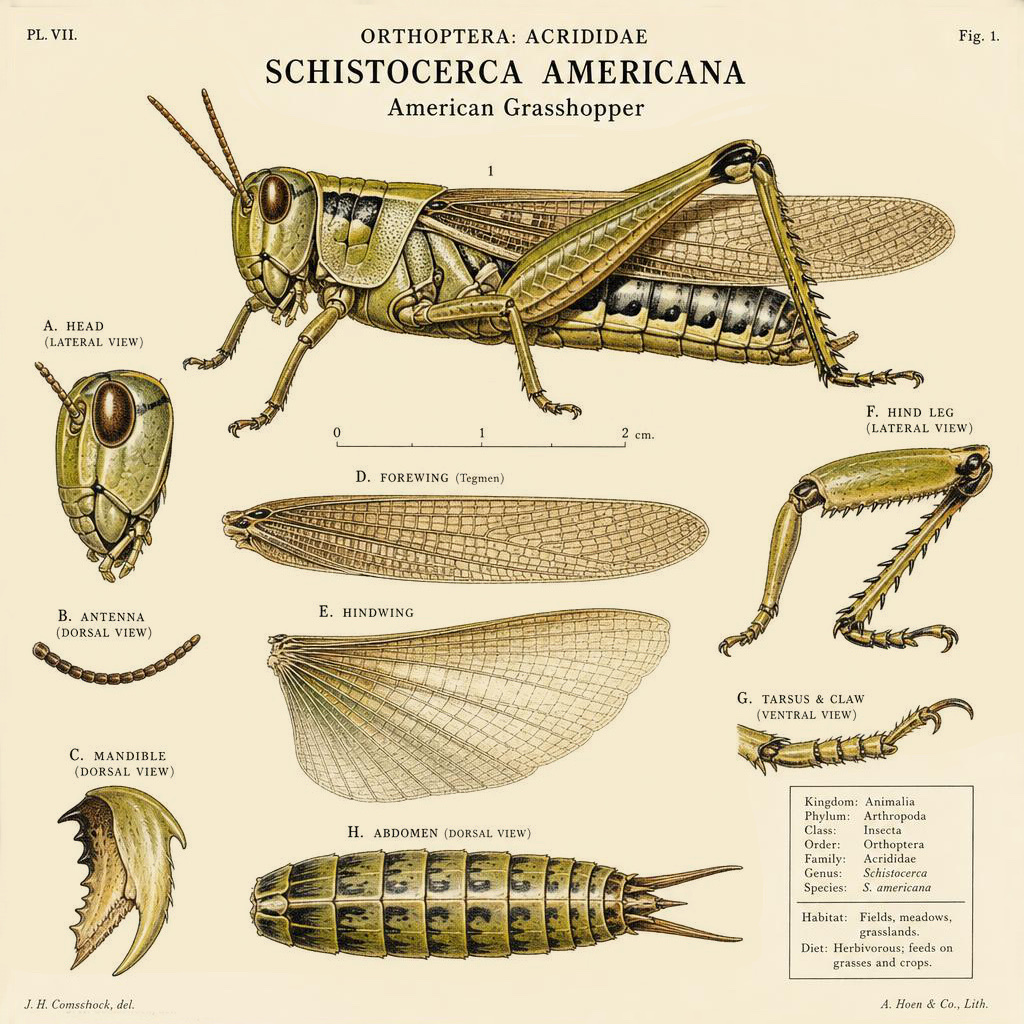

[Long Instrumental Intro — 1960s educational science-film orchestration, curious laboratory atmosphere, period strings, woodwinds, restrained percussion] [Spoken Scientific Narration — authoritative 1960s educational film narrator] The grasshopper. An efficient little machine of nature. Its body is divided into three principal regions: The head. The thorax. And the abdomen. A hard outer covering of chitin protects the body, forming an exoskeleton both lightweight and remarkably durable. On the head are two compound eyes, sensitive antennae, and powerful chewing mouthparts designed for a diet of grasses and other vegetation. [Instrumental Interlude — curious woodwind phrase, light strings, restrained period percussion] But the grasshopper’s most remarkable equipment is found on the thorax. Here are the great hind legs— long, muscular structures specially adapted for jumping. With a sudden contraction, the grasshopper can launch itself many times the length of its own body. Two pairs of wings provide additional movement, allowing many species to travel through the air. [Brief Instrumental Break — short scientific-documentary transition] And how does this small creature breathe? Not with lungs. Instead, air enters through tiny openings called spiracles. From these openings, an intricate network of tracheal tubes carries oxygen directly to the tissues. [Brief Instrumental Break — curious orchestral punctuation] The life cycle is equally efficient. The grasshopper undergoes incomplete metamorphosis. First, the egg. Then, the nymph. And finally, the adult. The nymph resembles the adult, but is smaller and lacks fully developed wings. With each successive molt, the young grasshopper grows. And there is one more curious feature. The sound of the grasshopper. Certain species produce their characteristic calls by rubbing specialized body structures together. A tiny orchestra— conducted entirely by anatomy. [Instrumental Interlude — slightly more expansive 1960s science-film theme] So, beneath the familiar appearance of this common field insect lies a remarkably organized biological system. Three body regions. Powerful jumping limbs. Wings. Tracheal respiration. Chewing mouthparts. And a life cycle repeated countless times across the grasslands of the world. The grasshopper. Small in size… but an extraordinary example of biological engineering. [Instrumental Outro — elegant 1960s educational-film theme, period strings and woodwinds, gradual musical conclusion]
