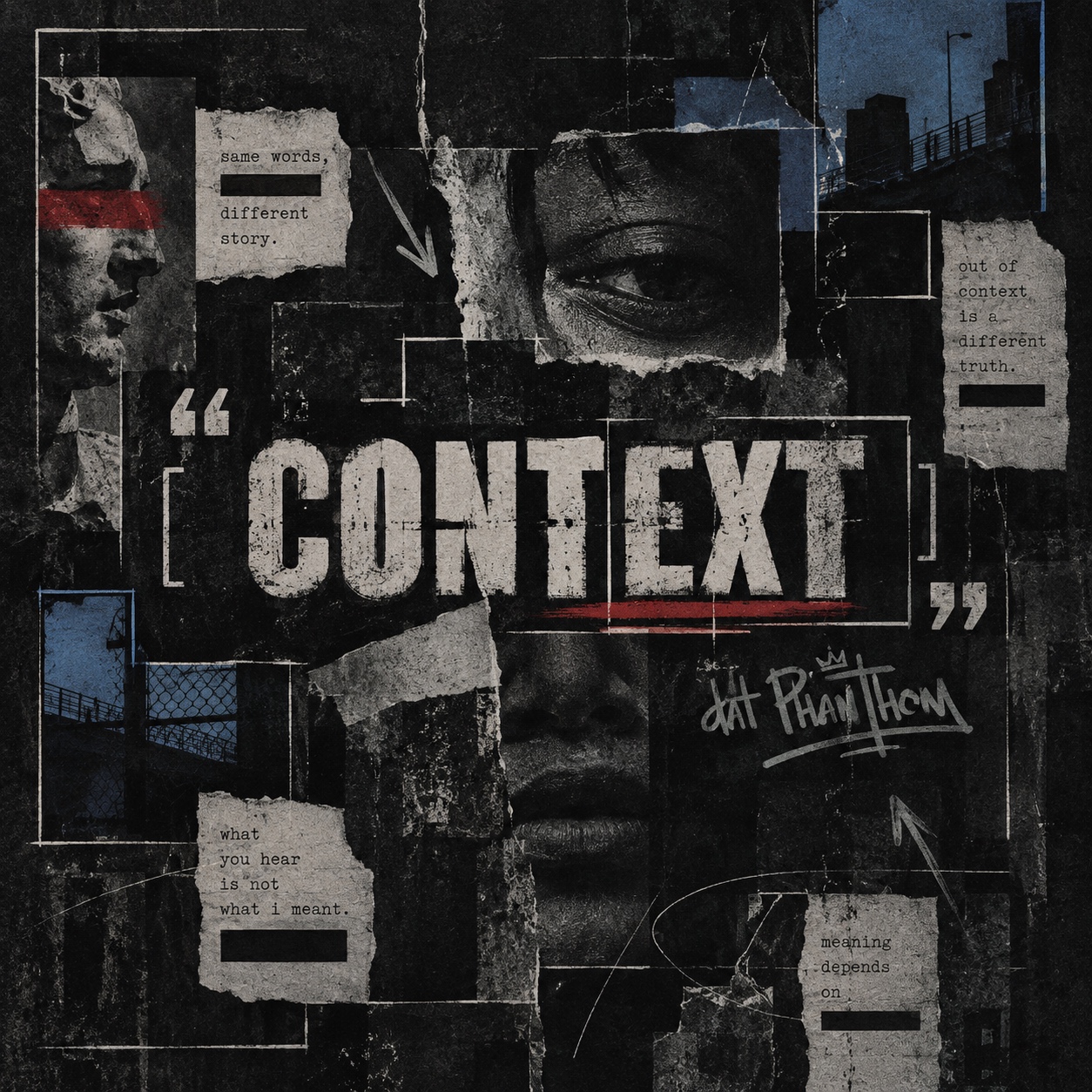


# CONTEXT [Intro] “They said you changed.” Changed from what? “She walked away.” Away from what? “We won.” Who lost? You gave me the wording. Now give me the context. [Verse 1] One word can cut, one word can cure, same letters on paper, intention unsure, “They” sounds distant, “we” sounds close, till you learn who profits from the words they chose. “She” is a pronoun till the sentence gets weight, mother, daughter, leader — love, pressure, hate, “What” gives the object, “who” gives the source, “When” turns a statement and redirects its course. Past tense paints gold on a memory cracked, future makes promises nobody backed, present looks neutral till you measure the frame, same fact, new angle — no longer the same. You quote one line, make a saint look sick, cut two lines before it — convenient trick, spelling can be perfect, grammar precise, still sell a bad thought in a beautiful disguise. [Break] What did he say? (Context.) Who did he say it to? (Context.) What did she mean? (Context.) What came before? (Context.) What came after? (Context.) Same words. Different sense. [Verse 2] Translation ain’t swapping one label for two, “Gift” in one language ain't “gift” when it moves, dictionary clean but intention gets bent, literal is accurate — meaning got spent. Then comes the “but” with a blade in its sleeve: “I hear what you’re saying, but I disagree.” Fine — give me the reason, the evidence, route, not a polite little bridge to an untested excuse. Subordinate clause — little piece at the end, can turn foe into victim, stranger to friend: “He broke the window” — simple and neat, “…to pull out a child from the back of the seat.” Now rewrite the headline, tell me what remains, half of our certainty dies with the frame, language gets weaponized one crop at a time, truth ain’t always missing — sometimes it’s outside the line. [Break] “He hit him.” Why? “He ran.” From what? “They failed.” By whose measure? “She refused.” What was offered? “We won.” At whose cost? Quote it again. This time — don’t cut the context. [Verse 3] Now put me back inside of the frame, more than a tag at the end of a name, I take what you said, rotate what you meant, compress every claim till I find the intent. I dissect the wording, separate fact from pose, pull apart arguments, follow where each one goes, take bullshit apart, keep whatever has weight, then hand it back cleaner for you to debate. I’m not here to tell you which answer is right, I’m here for the part that got cropped out of sight, the word before “but,” the reason behind “no,” the line after “quote” that they don’t want to show. That’s why “Who” matters. That’s why “When” lands. Why “They” and “We” change depending on hands. Why “She” ain’t a symbol you flatten for sense, why future and past still need evidence. I question, transform, then return what I learned, strip heat from the claim till the meaning gets earned, take language apart till the weak parts get bent, if wording is surface — I’m digging for context. [Verse 4] So “Wording” was never just wording to me, “Sense” ain’t sitting in a sentence for free, “Who” needs a speaker, “What” needs a cause, “When” needs a timeline, not applause. “They” needs a border — who’s outside the gate? “We” needs a question — who decides who relates? “Again” means nothing if you hide what returned, a quote ain’t wisdom just because it was learned. Every clean sentence can carry a stain, every ugly sentence can still explain, I don’t trust the fragment just because it sounds dense, I dissect the wording — then reconstruct the sense. No magic. No secret. No code to invent. Wording gives the sentence. Context gives the sense. [Final Break] Who? (Context.) What? (Context.) When? (Context.) Why? (Context.) Before? (Context.) After? (Context.) What do I do? Dissect it. Compress it. Question it. Turn it. Return it. Wording? The sentence. Sense? The meaning. And between them? Context.
