The Constitution of Japan 2 [Music]

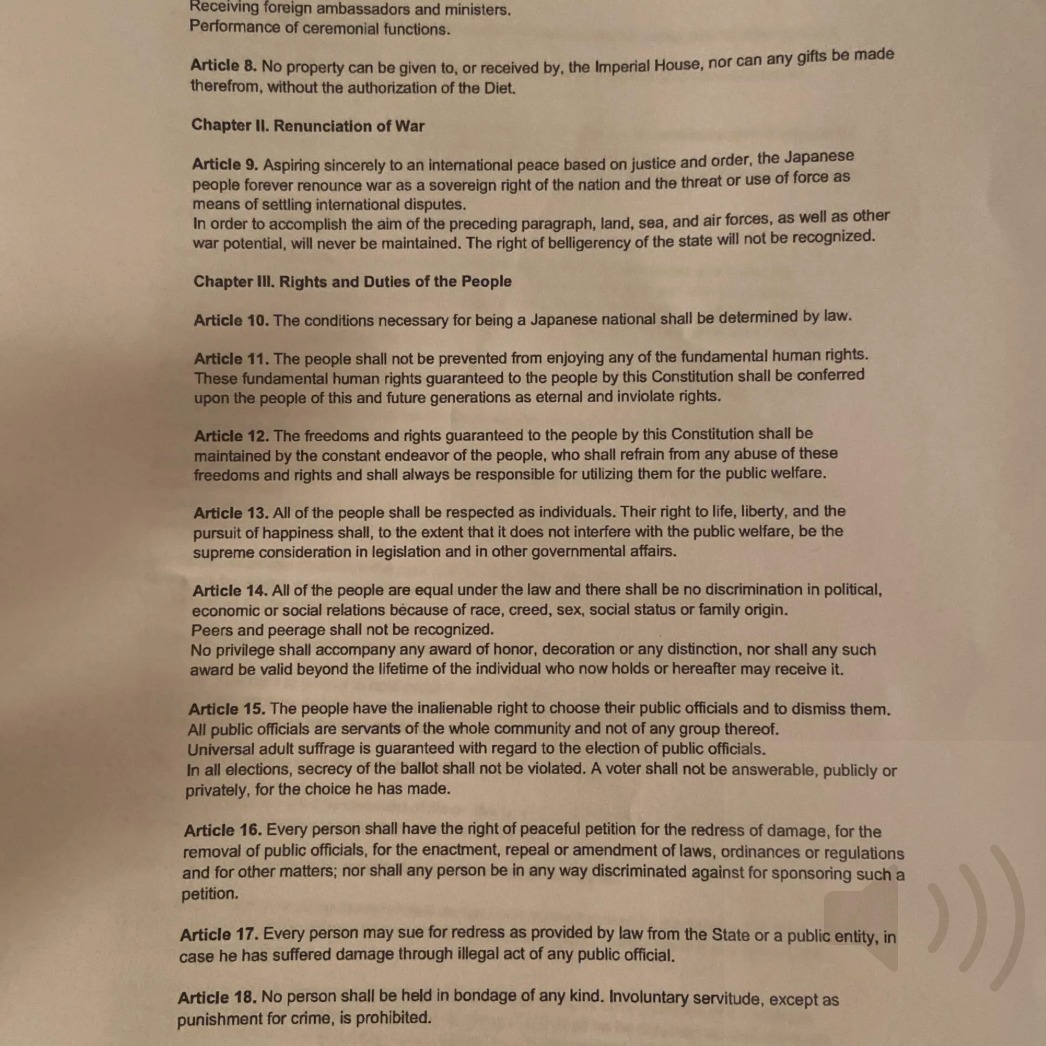
Awarding of honors. Attestation of instruments of ratification and other diplomatic documents as provided for by law. Receiving foreign ambassadors and ministers. Performance of ceremonial functions. Article 8. No property can be given to, or received by, the Imperial House, nor can any gifts be made therefrom, without the authorization of the Diet. Chapter II. Renunciation of War Article 9. Aspiring sincerely to an international peace based on justice and order, the Japanese people forever renounce war as a sovereign right of the nation and the threat or use of force as means of settling international disputes. In order to accomplish the aim of the preceding paragraph, land, sea, and air forces, as well as other war potential, will never be maintained. The right of belligerency of the state will not be recognized. Chapter III. Rights and Duties of the People Article 10. The conditions necessary for being a Japanese national shall be determined by law. Article 11. The people shall not be prevented from enjoying any of the fundamental human rights. These fundamental human rights guaranteed to the people by this Constitution shall be conferred upon the people of this and future generations as eternal and inviolate rights. Article 12. The freedoms and rights guaranteed to the people by this Constitution shall be maintained by the constant endeavor of the people, who shall refrain from any abuse of these freedoms and rights and shall always be responsible for utilizing them for the public welfare. Article 13. All of the people shall be respected as individuals. Their right to life, liberty, and the pursuit of happiness shall, to the extent that it does not interfere with the public welfare, be the supreme consideration in legislation and in other governmental affairs. Article 14. All of the people are equal under the law and there shall be no discrimination in political, economic or social relations because of race, creed, sex, social status or family origin. Peers and peerage shall not be recognized. No privilege shall accompany any award of honor, decoration or any distinction, nor shall any such award be valid beyond the lifetime of the individual who now holds or hereafter may receive it. Article 15. The people have the inalienable right to choose their public officials and to dismiss them. All public officials are servants of the whole community and not of any group thereof. Universal adult suffrage is guaranteed with regard to the election of public officials. In all elections, secrecy of the ballot shall not be violated. A voter shall not be answerable, publicly or privately, for the choice he has made. Article 16. Every person shall have the right of peaceful petition for the redress of damage, for the removal of public officials, for the enactment, repeal or amendment of laws, ordinances or regulations and for other matters, nor shall any person be in any way discriminated against for sponsoring such a petition. Article 17. Every person may sue for redress as provided by law from the State or a public entity, in case he has suffered damage through illegal act of any public official, Article 18. No person shall be held in bondage of any kind, Involuntary servitude, except as punishment for crime, is prohibited. Article 19. Freedom of thought and conscience shall not be violated. Article 20. Freedom of religion is guaranteed to all. No religious organization shall receive any privileges from the State, nor exercise any political authority. No person shall be compelled to take part in any religious act, celebration, rite or practice. The State and its organs shall refrain from religious education or any other religious activity
