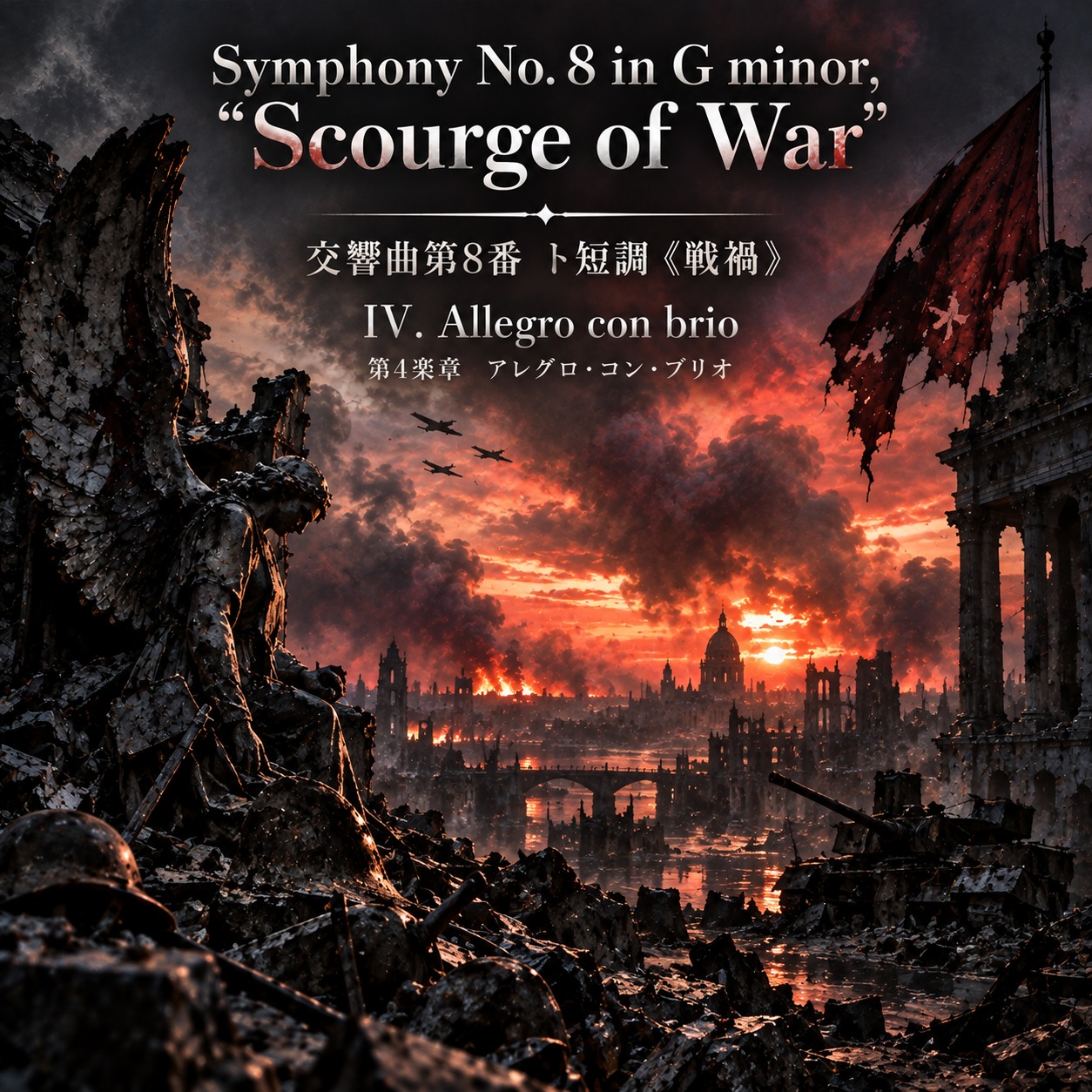

IV. Allegro con brio The Fourth Movement portrays the violence of the battlefield itself and the enormous machinery of war that continues to operate beyond individual human will, against the backdrop of a large-scale conflict reminiscent of the Second World War. From the opening, the full orchestra erupts with explosive force. Rapidly moving strings are attacked by brass and percussion, creating an immediate sense of being thrown into battle. There is nothing heroic or triumphant here. The dark sonority centered on E minor keeps any clear sense of “victory” at a distance. Short, fragmented motifs move rapidly between instrumental groups. Brass responds to rushing string figures with sharp chords, while sudden pauses and extreme dynamic changes repeatedly interrupt the flow. Yet the music never loses its forward momentum. Violent sound and tense silence stand side by side, like bombardment alternating with moments of terrifying stillness. The orchestral texture temporarily becomes lighter, bringing intricate string and woodwind figures to the foreground. But this is no escape from battle. Ominous motion remains in the lower register, continually accumulating tension toward the next collision. The alternation between violence and restraint becomes part of the movement’s structure, reflecting the unpredictable passage of time on a battlefield. In the central section, the fragmented writing gives way to comparatively long melodic lines led by the strings. For a moment, the human presence within this enormous conflict becomes visible. Yet unstable harmonies and restless motion remain beneath the melody, allowing the shadow of war to intrude even upon this brief stillness. In the latter half, the energy accumulated since the opening concentrates once again. Rapid string repetitions, roaring brass, and violent percussion overlap until individual melodic lines begin to disappear inside a massive orchestral sound. At this point, a particularly important role is given to a snare drum with the snares disengaged. With the characteristic rattle of the snare removed, only a dry, hollow drum sound remains, repeating a persistent rhythmic pattern. This is more than a military march. Its repetition evokes columns of soldiers, tanks and military vehicles, and ultimately the vast machinery of war itself—an organization that continues to advance regardless of individual human will. Like passages in Shostakovich’s wartime symphonies, pressure is intensified through the obsessive repetition of a simple rhythm. With every recurrence, the music seems to lose another possible route of escape. The percussion no longer merely supports the orchestra; it drives the entire orchestra forward. In the final section, motifs that had previously appeared in fragments are gathered into the full ensemble. Racing strings, forceful brass, and repeated percussion merge into a single enormous mass of sound as the war enters its final stage. But there is no celebration waiting at the end. The dark color of E minor remains, and the music refuses to slow significantly for a grand conclusion. Instead, the movement ends with short, decisive chords. This is not a finale proclaiming victory. It feels instead as though, after unimaginable sacrifice, only the fighting itself has finally stopped. The war that began and expanded in the First Movement reaches its destination here. Yet the Fourth Movement does not portray heroes or victors. Its true subject is war itself as an immense force, growing beyond the control of those who created it. What remains at the end is not the exhilaration of victory, but the weight left behind after everything has passed. ーーーーーーーーーーーーーーーーーーーーーー 第4楽章:Allegro con brio 第4楽章は、第二次世界大戦を思わせる大規模な戦争を背景に、戦場そのものが持つ暴力性と、人間の意思を超えて動き続ける巨大な戦争機構を描く。 冒頭から全管弦楽が鋭く炸裂し、細かく動き続ける弦楽器に金管楽器と打楽器が激しく食い込む。そこに英雄的な華やかさはなく、戦闘開始と同時に巨大な力へ放り込まれるような切迫感が支配する。ホ短調を中心とする暗い響きも、この楽章から明快な「勝利」の色彩を遠ざけている。 短く切断された動機は各楽器群を次々と移動し、弦楽器の急速な音型に金管楽器が鋭い和音で応答する。突然の休止や極端な強弱の変化によって音楽の流れは何度も寸断され、それでも前進する力だけは失われない。砲撃と静寂が交互に訪れる戦場のように、激しい音響と張り詰めた空白が隣り合っている。 その後、管弦楽の厚みが一時的に薄くなり、弦楽器と木管楽器による細かな運動が前面に現れる。しかし、それは戦闘から離れた安息ではない。低音部には絶えず不穏な動きが残され、次の衝突へ向けて緊張が蓄積されていく。激しい部分と静かな部分を交互に配置することで、戦場における時間の不規則さが音楽の構造そのものへ組み込まれている。 中間部では、それまでの断片的な動きから離れ、弦楽器を中心に比較的長い旋律線が現れる。ここで初めて、戦争という巨大な出来事の中に存在する「人間」の姿が浮かび上がる。しかし旋律の背後から不安定な和声や細かな動きが消えることはなく、束の間の静けさにも戦争の影が付きまとう。 後半に入ると、冒頭から積み重ねられてきたエネルギーが再び集中し、楽章はさらに苛烈な様相を呈する。弦楽器の急速な反復、金管楽器の咆哮、打楽器の強打が幾重にも重なり、個々の旋律よりも巨大な音響そのものが前面へ押し出されていく。 その中で重要な役割を担うのが、スネア線を外したスネアドラムである。 通常のスネアドラム特有の鋭い響きを消し、乾いた胴鳴りだけとなった音が一定のリズムを執拗に刻み続ける。その反復は単なる軍隊の行進ではない。兵士の隊列、戦車や軍用車両、そして命令によって動き続ける巨大な組織――個人の意思とは無関係に前進を続ける戦争機構そのものへと姿を変えていく。 ショスタコーヴィチの戦争期の交響曲にも通じる、単純なリズムの反復によって圧力を増幅させる場面であり、繰り返されるほど音楽から逃げ場が失われていく。ここでは打楽器がオーケストラを支えるのではなく、逆にオーケストラ全体を前方へ追い立てている。 終結部では、それまで散在していた動機が全管弦楽へ集約される。激しく動き続ける弦楽器、金管楽器の強奏、打楽器の連打が巨大な一つの音響となり、戦争は最後の局面へ突入する。 しかし、その先に祝祭は用意されていない。 最後までホ短調を基盤とする暗い色彩を残し、速度を大きく緩めることなく、短く断固とした和音によって楽章は閉じられる。それは戦勝を宣言するフィナーレではなく、膨大な犠牲を残した末に、ただ戦闘だけが終わったかのような結末である。 第1楽章で始まり、拡大していった戦争。その行き着く先として置かれた第4楽章は、英雄や勝者ではなく、戦争という巨大な存在そのものを描く。最後に残されるのは勝利の高揚ではなく、すべてが通り過ぎた後の重さである。

0/500