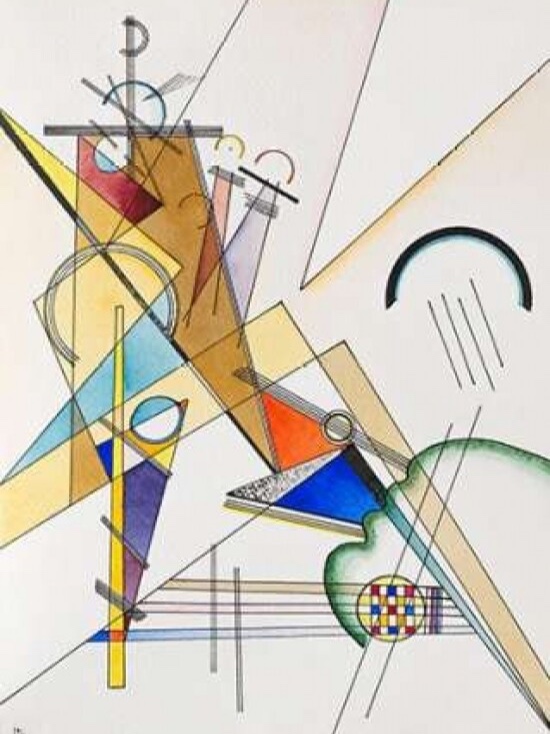
The Geometry of Meaning: Cultural Abstraction (See note about lyrics.)

In the lineage of Modern Art, abstraction was never merely a departure from figuration or a rebellion against realism; it was a radical quest for the Ur-language of art—a primordial syntax that predates written script and pictorial representation, residing instead within the deep structures of form and color. Since the dawn of the 20th century, when visionaries like Wassily Kandinsky, Kazimir Malevich, and Piet Mondrian declared that fundamental geometric shapes could encapsulate the purity of human experience, the triangle, square, circle, and the primary triad of yellow, red, and blue became the new alphabet of modernity. However, this alphabet was never alien to the visual heritage of non-Western cultures. For centuries, Islamic and Arabic arts have been anchored in a sophisticated geometric order defined by repetition, symmetry, rhythm, and a sublime economy of form. In this context, these contemporary experiments can be read as a conscious endeavor to reconnect modern abstraction with its ancient, localized cultural roots. These works—inspired by Al-Qatt Al-Asiri and the folk motifs of Najd and Al-Ahsa—do not merely borrow superficial ornamentation. Instead, they reclaim a deep structural and chromatic logic, where geometric forms and primary colors evolve into a visual system capable of carrying both collective memory and identity. Abstraction as the Evolution of Heritage Modern abstraction is often perceived as a "universal language" detached from cultural particularities. Yet, this practice proposes a different trajectory: Cultural Abstraction. Here, the geometric form is never neutral; it is saturated with civilizational references. The recurring triangles, rhythmic lines, and points within these canvases evoke the spirit of Al-Qatt Al-Asiri—the mural art perfected by the women of the Asir region over centuries—where walls were transformed into vibrant, geometric landscapes. Simultaneously, we find echoes of Najdi motifs—triangular compositions, geometric stars, and circular mandalas—alongside visual rhythms reminiscent of the architectural heritage of Al-Ahsa. These elements undergo a process of reduction, distilling them into foundational shapes that resemble a "Visual Genesis," blending local soul with global language. The Square: The Order of the Terrestrial In contrast to the triangle’s ascent, the square serves as the element of stability. It is the form most intimately linked to the earth and architecture, reflecting notions of order and equilibrium. It functions as a "cradle" or a cultural vessel containing identity. While it echoes the functionalist aesthetics of the Bauhaus, the square here transcends mere construction to become a "topographical signifier" of local roots. The Circle: The Celestial Energy Center The circle is the most poetic element—a form without beginning or end, a perennial symbol of totality and infinity. It appears as a symbolic sun or a "Cosmic Eye," radiating energy through radial motifs. It creates a spiritual focal point that balances the triangle’s drive and the square’s stillness, acting as the nexus where lines of visual force intersect. The Synthesis of Tradition and Modernity What distinguishes this experience is the seamless integration of the structural logic of Arab-Islamic art with European modernism. The interplay of primaries and geometry recalls the De Stijl movement’s quest for equilibrium and Mondrian’s meticulous spatial organization. Yet, the essential difference remains: this abstraction is not born of "formal purity" alone, but from a desire to evolve local visual memory. Geometry is not just a system; it is a cultural reservoir of time and place. The Geometry of Identity The Geometry of Identity The Geometry of Identity The Geometry of Identity The Geometry of Identity
