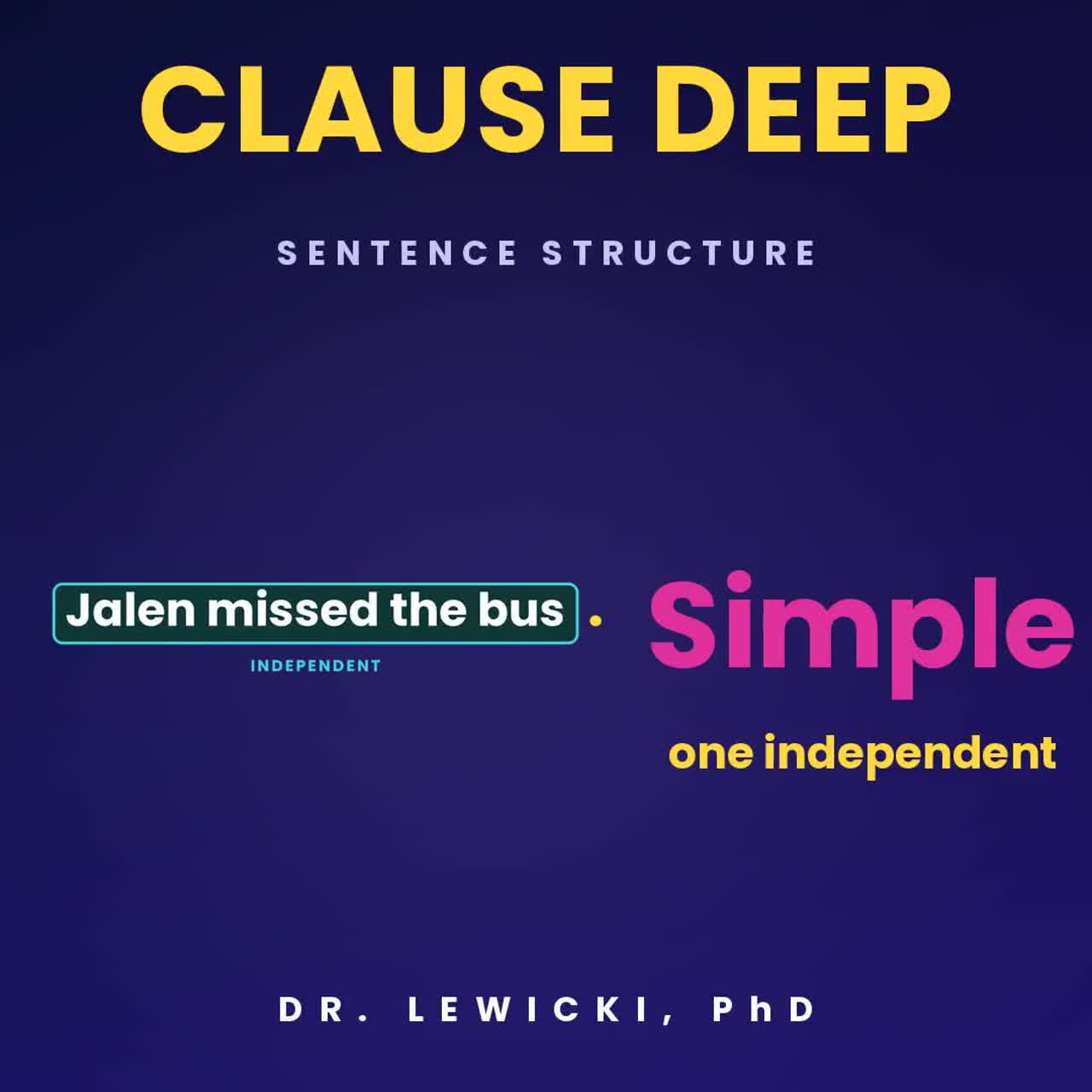

[Intro: 4 bars, piano and bass] Pencils up. Sentences are built from clauses. Clause deep. [Hook 1] Clause deep! (Clause deep!) Subject plus verb? (Clause!) Stands alone? (Independent!) Because, although, when, if? (Dependent!) Two independents? (Comma, FANBOYS!) Or no conjunction? (Semicolon!) Count the clauses! (Now you know!) [Verse 1] A clause — a group of words with a subject and a verb, Subject — who or what; verb — the action or state. Independent clause — a complete thought — stands alone: "Jalen missed the bus." Subject: Jalen. Verb: missed. Complete. Dependent clause — subject and verb, but not a complete thought: "Because Jalen missed the bus" — because what? It leaves you hanging. A subordinating conjunction starts it — because, although, when, if, since, After, before, while, until — they make it depend. Phrase or clause? "After the game" — no verb — a phrase. "After the game ended" — subject, verb — dependent clause. Simple — one independent clause: "Jalen missed the bus." "Jalen and Maya missed the bus and walked" — still simple: Two subjects, two verbs, but one clause. Simple doesn't mean short — it means one independent clause. [Hook 2] Clause deep! (Clause deep!) Subject plus verb? (Clause!) Stands alone? (Independent!) Because, although, when, if? (Dependent!) Two independents? (Comma, FANBOYS!) Or no conjunction? (Semicolon!) Count the clauses! (Now you know!) [Verse 2] Compound — two or more independent clauses, joined: A comma plus a FANBOYS — for, and, nor, but, or, yet, so. "Jalen missed the bus, so he walked to school." Or a semicolon: "Jalen missed the bus; he walked." Complex — one independent plus at least one dependent: "Because Jalen missed the bus, he walked." "Although it rained, we played." "If you study, you'll be ready." "Since the gym closed, we ran." "When the bell rang, we left." Dependent first? Comma after it. Independent first? Usually no comma: "We left when the bell rang." Compound-complex — two or more independents plus at least one dependent, Two that stand, one that leans — compound-complex. [Hook 3] Clause deep! (Clause deep!) Subject plus verb? (Clause!) Stands alone? (Independent!) Because, although, when, if? (Dependent!) Two independents? (Comma, FANBOYS!) Or no conjunction? (Semicolon!) Count the clauses! (Now you know!) [Instrumental Break] [Beat switch] [Verse 3] Worked example — one idea, built up: Simple: "The field flooded." One subject, one verb — one clause. Compound: "The field flooded, so practice was canceled." Two independents — comma plus so — each stands alone. Complex: "Because the field flooded, practice was canceled." "Because the field flooded" — dependent — comma after it. Flip it: "Practice was canceled because the field flooded." No comma. Compound-complex: "Because the field flooded, practice was canceled, and Jalen went home." Two independents — practice was canceled, Jalen went home — Plus one dependent — because the field flooded. Same idea, four structures — count the clauses, not the words. [Breakdown] "Maya laughed." (Simple!) "Maya laughed, and Jalen smiled." (Compound!) "When Maya laughed, Jalen smiled." (Complex!) "When Maya laughed, Jalen smiled, but Coach frowned." (Compound-complex!) "Because Maya laughed." (Fragment!) Two sentences, just a comma? (Comma splice!) Two sentences, nothing between? (Run-on!) Fix a splice? (FANBOYS or semicolon!) [Verse 4] Three errors to fix. Fragment — missing a subject, a verb or a complete thought: "Because the bus was late." A dependent clause alone — a fragment. Fix: attach an independent — "Because the bus was late, Maya ran." Comma splice — two independents joined by only a comma: "The bus was late, Maya ran." A comma alone is too weak. Fix: add a FANBOYS — "The bus was late, so Maya ran" — Or a semicolon, or a period — make it two sentences. Run-on — two independents fused, nothing between: "The bus was late Maya ran." Fix it the same ways, Or make one dependent — the complex fix. However isn't a FANBOYS — a comma before it makes a splice. Use a semicolon: "The bus was late; however, Maya made it." A semicolon joins two independents — never a dependent clause. One subject, two verbs? No comma: "Maya grabbed her bag and left." [Hook 4] Clause deep! (Clause deep!) Subject plus verb? (Clause!) Stands alone? (Independent!) Because, although, when, if? (Dependent!) Two independents? (Comma, FANBOYS!) Or no conjunction? (Semicolon!) Count the clauses! (Now you know!) [Hook 5] Clause deep! (Clause deep!) Subject plus verb? (Clause!) Stands alone? (Independent!) Because, although, when, if? (Dependent!) Two independents? (Comma, FANBOYS!) Or no conjunction? (Semicolon!) Count the clauses! (Now you know!) [Outro] "Since the game went long, we ate late, and Maya fell asleep." Which type? Since the game went long — dependent. We ate late — independent. Maya fell asleep — independent. Two plus one — compound-complex. Clause deep. Class dismissed. [Instrumental Outro]
