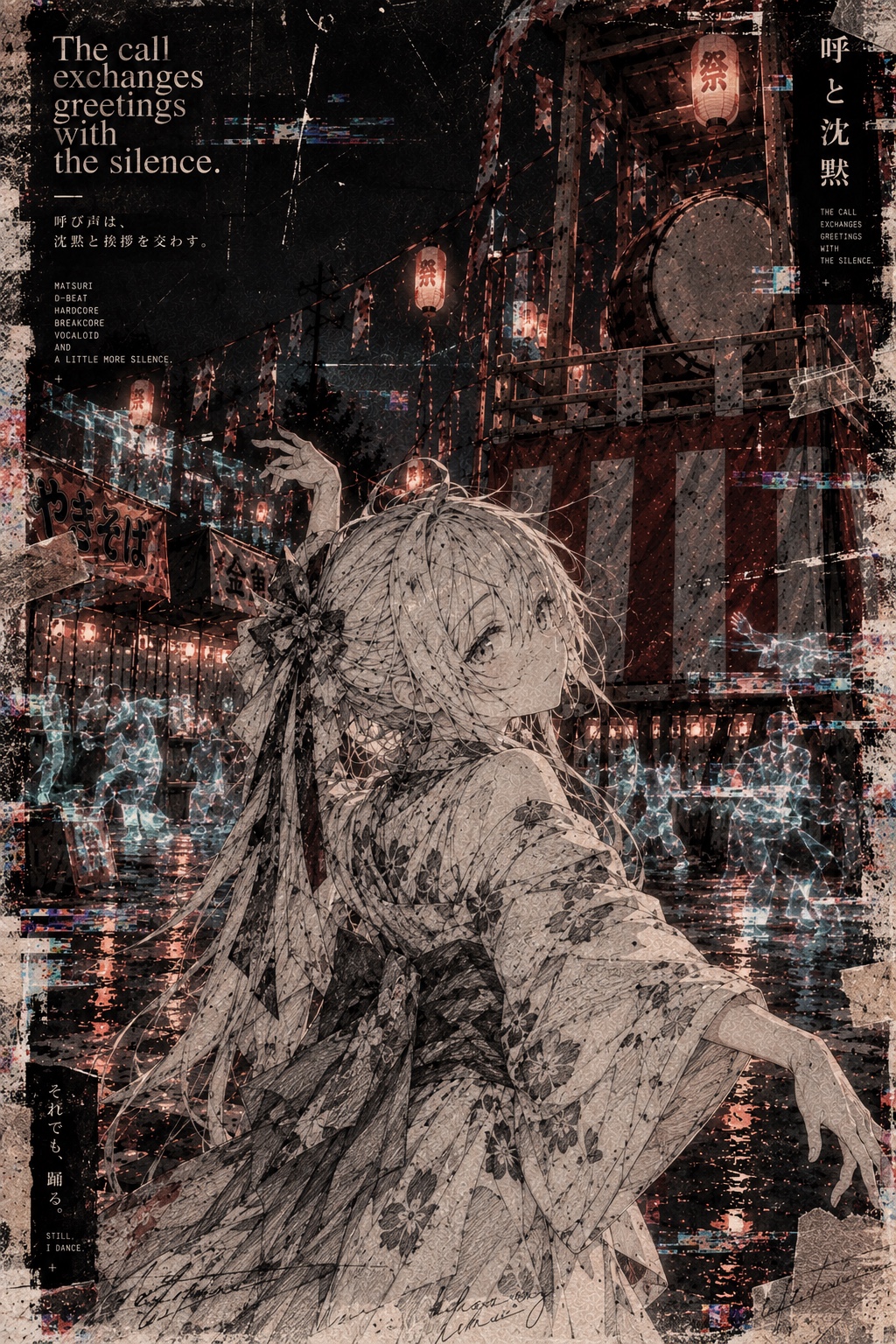
Inst.. - The call exchanges greetings with the silence.

[Festival calls use a high, childlike synthetic Vocaloid-style voice: bright, thin, slightly nasal and sharply articulated. It sounds playful and commanding, never sweet or sentimental. No full sung lines. Present one clear raw call before chopping that exact vocal timbre into syllables, consonants and breath. Preserve its recognizable identity as the samples deteriorate.] [BREAKCORE REMIX OF THE SOURCE TRACK] [Preserve the source track’s guitar riff, bass line, D-beat momentum and main harmonic identity.] [Hardcore band in the foreground. Festival instruments appear in brief gaps and structural accents.] [No lead singing or melodic vocal verse. Human voices are short festival calls and later sampled fragments.] [SOURCE SOUND — HARDCORE BAND] [Drum kit: raw acoustic kick with a firm low punch; dry, cracking snare with an audible room tail; rough, rattling cymbals. Preserve uneven human accents. Avoid plastic programmed drums.] [Bass: heavily driven electric bass with a clearly audible pick attack and gritty midrange. Follow the band’s forward motion without becoming a smooth synth sub-bass.] [Guitar: abrasive distorted electric guitar, short palm-muted attacks and open ringing ends. Keep the recognizable source riff. Avoid virtuosic solos and a continuous wall of chugging.] [The band should sound like players pushing together in one crowded room.] [OPENING — RAW BAND] [Begin with the source guitar, bass and D-beat drums.] [Establish the complete physical groove before introducing any electronic edits.] [FESTIVAL SOUND — RAW MATERIAL] [Shakuhachi: breath-forward bamboo tone, rough initial air, slightly unstable pitch and a strong focused body. Brief commanding calls in the place a lead singer would occupy; no smooth synth-flute pad.] [Shamisen: woody, sharp plucked attacks with a short buzzing decay. Only a few notes in the gaps between guitar phrases; no continuous runs or guitar-like solo.] [Taiko: deep skin impact with a natural, uneven decay. Use for selected responses and major accents.] [Shime-daiko: tighter skin sound, two players answering rather than playing constant unison.] [Kane: hard metallic strike that clarifies the recurring festival cycle.] [Bell: bright, clean, narrow high-register tone. Rare punctuation at an edit or sudden turn; no constant glittering arpeggio.] [Present each sound clearly at least once before sampling or processing it.] [RAW FESTIVAL CALL] [One rough human voice from inside the ensemble; short and unpitched.] ソレッ! [The guitar and drums answer. Leave a small gap.] [SECOND CALL] [Two or three voices answer, slightly unequal in timing; no choir harmony.] ハッ! ソレ! [Return to the band riff.] [FIRST CUT — PRESERVE SOURCE TIMBRE] [Take a short slice from the already heard acoustic snare and shime-daiko.] [Move the slice to an unexpected position, but let its original room tone remain audible.] [Remove one expected central hit. Leave the hole open.] [VOICE SOURCE] [One high, childlike synthetic Vocaloid-style voice.] [Bright, thin, slightly nasal; crisp consonants and abrupt endings.] [The voice gives rhythmic festival commands, not a sung melody.] [No adult shouts, choir, cute pop chorus or long lyrical phrases.] [Keep the same voice identity in every later sample.] [RAW CALL — clearly heard once] [Close and dry; one short commanding attack.] ソレッ! [ENSEMBLE RESPONSE] [The band answers; the synthetic voice stays silent.] [SECOND CALL] [Same voice, more insistent; slight digital doubling only on the final syllable.] ハッ! ソレッ! [SAMPLED RETURN] [Replay the earlier calls as the same recorded voice, with visibly abrupt cuts.] ソレッ! ソレッ! [SYLLABLE CHOP] [Hard cuts between the voice sample and short shamisen attacks.] ソ、レッ。 ソ、ソ、レッ! [PHONEME CHOP] [The call loses its word shape but retains the same thin synthetic timbre.] ッ、ソ。 レッ、レッ。 ハッ——ッ。 [FINAL CALL] [One intact command cuts through the full hardcore band.] ソレッ! [Its sampled fragments answer from different rhythmic positions.] ソ、レッ、ッ。
