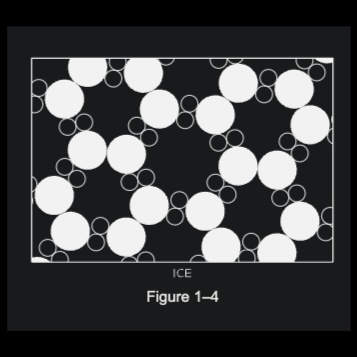

Let us consider another situation. Suppose that the piston moves inward, so that the atoms are slowly compressed into a smaller space. What happens when an atom hits the moving piston? Evidently, it picks up speed from the collision. You can try it by bouncing a ping-pong ball from a forward-moving paddle, for example, and you will find that it comes off with more speed than that with which it struck. If an atom happens to be standing still and the piston hits it, it will certainly move. So the atoms are hotter when they come away from the piston than they were before they struck it. Therefore, all the atoms which are in the vessel will have picked up speed. This means that when we compress a gas slowly, the temperature of the gas increases. So, under slow compression, a gas will increase in temperature, and under slow expansion it will decrease in temperature. We now return to our drop of water and look in another direction. Suppose that we decrease the temperature of our drop of water. Suppose that the jiggling of the molecules of the atoms in the water is steadily decreasing. We know that there are forces of attraction between the atoms, so that after a while they will not be able to jiggle so well. What will happen at very low temperatures is indicated in Figure One Dash Four: the molecules lock into a new pattern which is ice. This particular schematic diagram of ice is wrong because it is in two dimensions, but it is right qualitatively. The interesting point is that the material has a definite place for every atom, and you can easily appreciate that if somehow or other we were to hold all the atoms at one end of the drop in a certain arrangement, each atom in a certain place, then because of the structure of interconnections, which is rigid, the other end miles away — at our magnified scale — will have a definite location. So if we hold a needle of ice at one end, the other end resists our pushing it aside, unlike the case of water, in which the structure is broken down because of the increased jiggling so that the atoms all move around in different ways. The difference between solids and liquids is, then, that in a solid the atoms are arranged in some kind of an array, called a crystalline array, and they do not have a random position at long distances; the position of the atoms on one side of the crystal is determined by that of other atoms millions of atoms away on the other side of the crystal. Figure One Dash Four is an invented arrangement for ice, and although it contains many of the correct features of ice, it is not the true arrangement. One of the correct features is that there is a part of the symmetry that is hexagonal. You can see that if we turn the picture around an axis by sixty degrees, the picture returns to itself. So there is a symmetry in the ice which accounts for the six-sided appearance of snowflakes. Another thing we can see from Figure One Dash Four is why ice shrinks when it melts. The particular crystal pattern of ice shown here has many holes in it, as does the true ice structure. When the organization breaks down, these holes can be occupied by molecules. Most simple substances, with the exception of water and type metal, expand upon melting, because the atoms are closely packed in the solid crystal and upon melting need more room to jiggle around, but an open structure collapses, as in the case of water. Now although ice has a rigid crystalline form, its temperature can change — ice has heat. If we wish, we can change the amount of heat. What is the heat in the case of ice? The atoms are not standing still. They are jiggling and vibrating. So even though there is a definite order to the crystal — a definite structure — all of the atoms are vibrating in place. As we increase the temperature, they vibrate with greater and greater amplitude, until they shake themselves out of place. We call this melting. As we decrease the temperature, the vibration decreases and decreases until, at absolute zero, there is a minimum amount of vibration that the atoms can have — but not zero. This minimum amount of motion that atoms can have is not enough to melt a substance, with one exception: helium. Helium merely decreases the atomic motions as much as it can, but even at absolute zero there is still enough motion to keep it from freezing. Helium, even at absolute zero, does not freeze, unless the pressure is made so great as to make the atoms squash together. If we increase the pressure, we can make it solidify.
