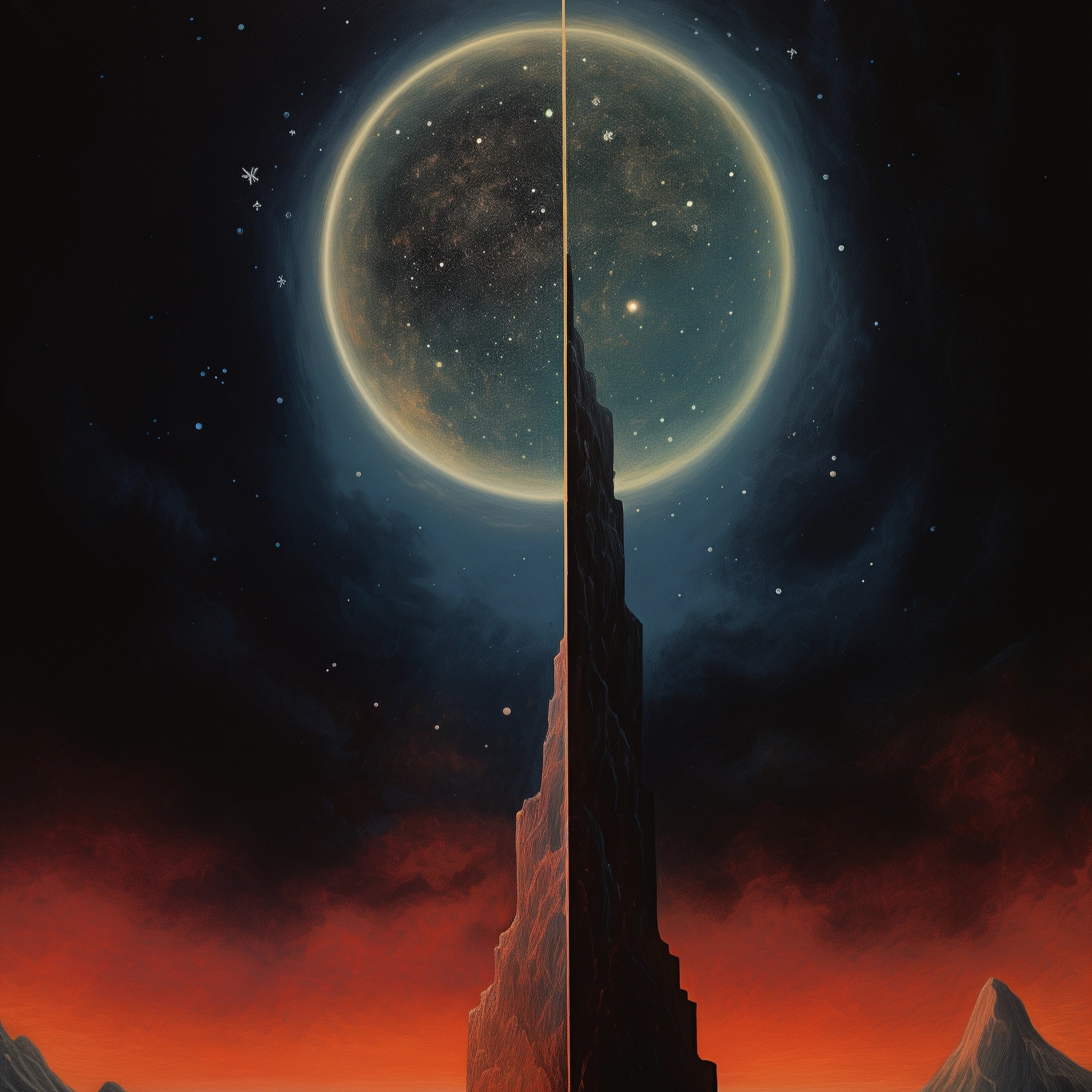

In the twilight of an alien dusk, as the horizon bled into a deep crimson, we came upon what I would later call the "Moon Splitter". It was an imposing spire, rising like a monolith dedicated to the gods of old, carved from the very bedrock of a world whose name we had yet to speak. The "Moon Splitter" was aptly named for its most enigmatic feature: an optical illusion so perfect, so precise, that it seemed to cleave the moon in two as it hung low behind it. The sight was uncanny, the way the celestial sphere appeared to be perfectly bisected by the monolith's edge, creating a spectacle that was both beautiful and unsettling. Theories abounded among my team. Some posited that it was the work of an ancient civilization, their technology lost to time, capable of manipulating matter in ways we could not fathom. Others whispered of titanic beings, creatures of myth who shaped the worlds as they walked. The steps that led to its base were hewn from the same dark stone, worn smooth by the winds of time. As we ascended, the air grew thinner, and the sense of otherworldliness grew stronger. The monolith did not merely divide the moon; it seemed to split reality itself, drawing a line between the world we knew and one that existed only in the realm of possibility. At the summit, we stood in the shadow of the monolith, gazing up at the phenomena. The monolith itself was a marvel of precision, its surface smooth and cold to the touch, defying the natural chaos of the surrounding landscape. It worked not through any visible mechanism but through an alignment so precise it seemed as though the universe had been designed around it. As the moons of this foreign world rose and set, the "Moon Splitter" performed its silent magic, a trick of light and shadow that left us questioning our understanding of the cosmos. It stood there, not just as a monument but as a question asked by the planet itself, a riddle etched into the very land it crowned.

0/500