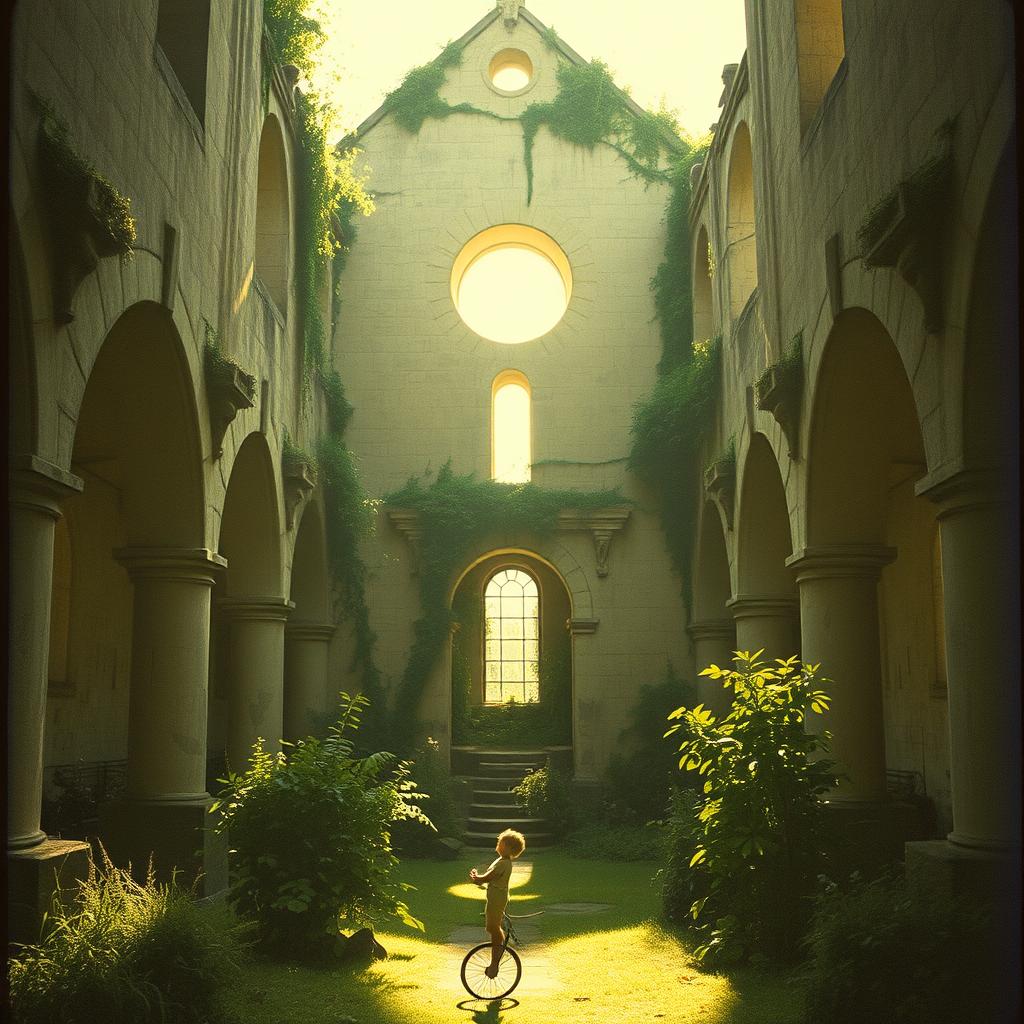
Visit to the Abbey Ruins of Villers with Danielle

Sauvages, full of stories. The ruins of the Abbey of Villers are located two kilometers from the station on the Ottignies–Charleroi line. The town of Villers-la-Ville, in the province of Walloon Brabant, houses these remains, stretching through the broad valley of the Thyle, surrounded by fields, meadows, and wild groves. Founded in the year eleven hundred forty-six by monks from Clairvaux, Villers quickly became a great Cistercian house. The abbey prospered in the Middle Ages, established dependencies, and received the burials of many seigneurial families. After centuries of history, the abbey was abandoned during the French Revolution at the end of the eighteenth century, then became a romantic ruin, frequented from the nineteenth century onward. To enter is to gain access to the skeleton of a stone monster: the abbey church, vast and elongated, shows its piers, its ribs, and the silhouette of its chevet. The cloister, the chapter house, the monks’ refectory with its alternating columns and its tall lancet windows, read like the chapters of an architecture book open to the wind. One still sees the crypt, the armarium, walls, gables, and bays, standing like exposed ribs. These elements, still upright, give the visitor the feeling of being inside the skeleton of an ancestral monument, a unique pleasure of reading the bare structure, without the decoration of a reconstructed church. The chevet was begun around the year eleven hundred ninety-seven; the choir rose around the year twelve hundred seventeen; the crypt was finished around the year twelve hundred forty; the refectory was built in the middle of the thirteenth century. The abbey church is distinguished by a remarkable use of oculi: those small circular openings, sometimes combined with lancets. In this architecture dotted with ox-eyes, the choir receives a singular play of light. Pierced through the wall, they appear as orbits watching the landscape and the valley. When the light passes through them, they make the space breathe. The tomb of Gobert of Aspremont, a crusader who became a monk at Villers, who died in the year twelve hundred sixty-three, holds a special place in the memory of the cloister. His burial site long remained a point of interest, and his recumbent effigy was the subject of reconstructions in the twentieth century. Dukes of Brabant, Henry the Second and others as well, were buried or commemorated in the abbey. Some ducal funerary monuments disappeared or were dispersed, as though history itself had wished to dissolve them into the ruin. The ruin offers the plan: instead of a finished décor, one reads the forces of stone, vaults, arches, columns, stripped of their ornamental garment. One sees the hand that built. Absence restores presence: the broken effigy, the fragment set upon the ground, the empty niche tell a human story more direct than any showcase. The landscape enters the stone: the Thyle, the sky, the woods take possession of the bays and let the ruin breathe. On the evening of our visit, a troupe of actors performed Shakespeare’s Romeo and Juliet. From afar, then closer, musicians accompanied the troupe to the sound of bagpipes. At intermission, in the cool air, a hot soup was served near an open fire brazier, contained in a large basin. Villers-la-Ville, its nature, its ghosts, its architectural soul tormented by time and nature, all of this still dwells in my inner landscape and haunts me.
