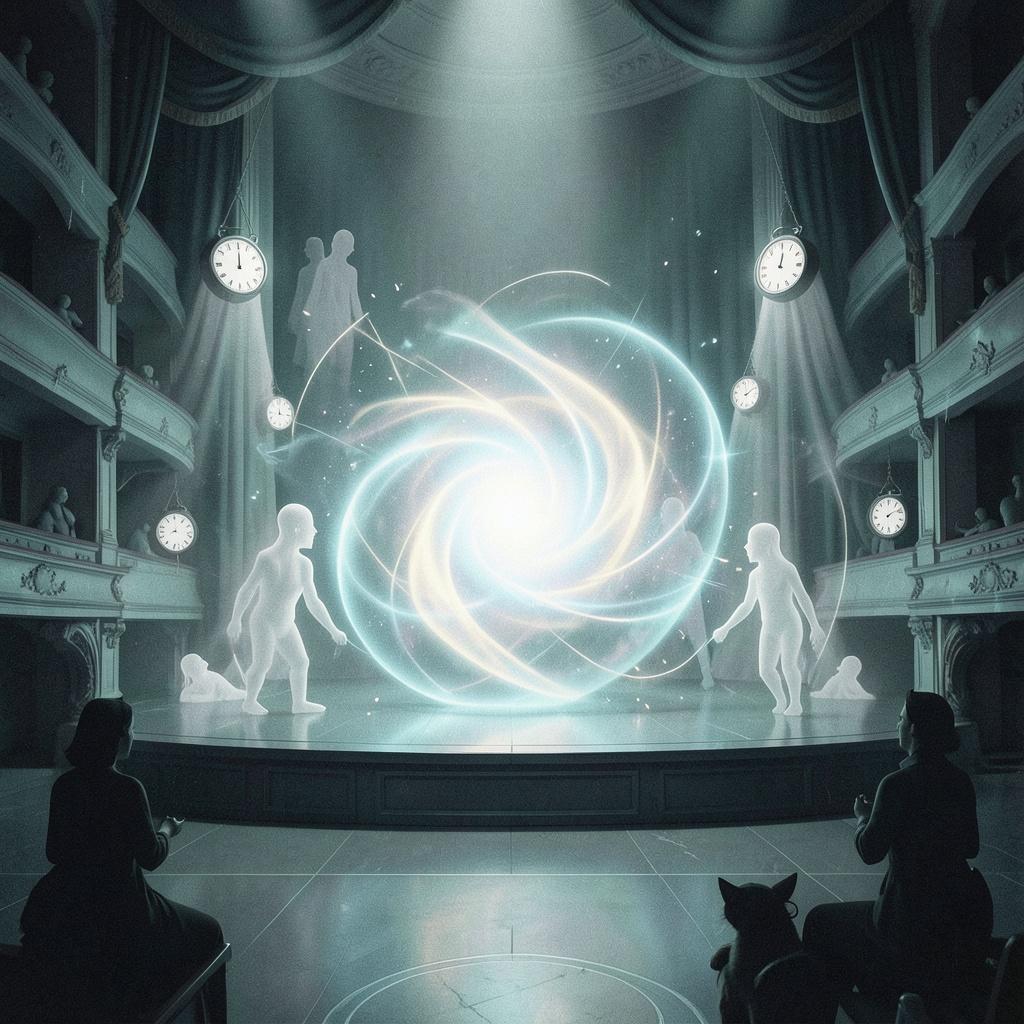

Tonight, before your eyes, a tragedy shall be performed. But this tragedy is not of a particular nation, of a particular era. It is the tragedy of every nation, of every era. Russia's, Israel's, America's, Iran's, and — your nation's. The words upon this stage point to no specific history. Yet, within your hearts, those words shall resonate with the histories you know. One thing, I would have you carry with you. Hannah Arendt — a German-Jewish political philosopher of the twentieth century. She fled from Nazi Germany, and after the war, attended the trial in Jerusalem of Adolf Eichmann, a senior Nazi official. And then, she wrote. Eichmann was not a devil. Nor was he a fanatical antisemite. He was merely — a banal bureaucrat. Calmly, he stamped documents. Calmly, he calculated the number of train cars. Calmly, he dispatched millions of lives to the camps. Arendt called this: The Banality of Evil. And then, Arendt wrote of its essence, thus: Eichmann's problem was not that he was stupid. What he lacked, decisively — was imagination. He could not imagine what each mother, each child, each young person in the packed train cars was feeling. He could not — imagine. Because he could not imagine, he could calmly execute his duty. The essence of the banality of evil — is the lack of imagination. Tonight, you shall see two kinds of human beings upon this stage. One — those who lack imagination. The Prime Minister. The First Bureaucrat. The Second Bureaucrat. They bow toward the empty gyokuza, performing their duties. They cannot imagine that beyond that gyokuza, a single life exists. The other — those who are filled with imagination. Amaga Kimizu — a young man of eighteen. Shinra Dōjin — the Heian-era prophet. Tachibana Kibi — the witness of ten thousand years. Kamunabi Nabari — the priest from before the chronicles. Mikotome Kukuru — the poet of an indeterminate era. Jinguji Osamu — the vessel of the present age. They, across time, imagine others. Do you possess imagination? The tragedy about to be performed upon this stage — can you imagine it? Or — shall you merely sit in your seats, waiting for the hours to pass? Hold that question in your hearts, as you watch. The curtain rises.
