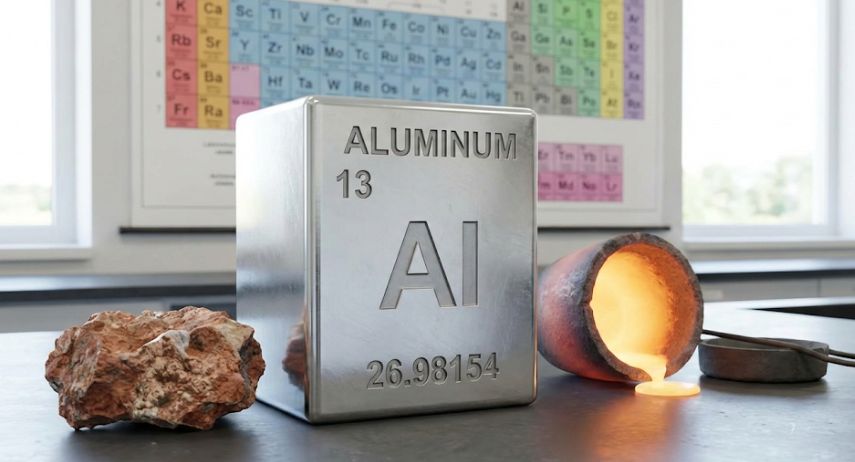

(Verse 1) Sitting at spot number thirteen, light as a feather, tough and lean. In the boron group, row number three, I’m the metal that sets the modern world free. I don't rust away like iron does, I’ve got that oxide shield, creating a buzz. From the soda can in your cold hand, To the wings of a jet flying over the land. (Chorus) Aluminum! You’re the crust’s best friend. Malleable, ductile, you bend but don’t end. Conducting the heat, conducting the spark, Shining so bright, lighting up the dark. Oh, Al! You’re the lightweight king! (Verse 2) Hidden in Bauxite, deep in the clay, Waiting for science to clear the way. Strip away the oxygen, break the bond, Of the shiny silver metal of which we are fond. Recycle me once, recycle me twice, I save all that energy, isn't that nice? It is a common misconception that iron is the most abundant metal in the Earth's crust. While iron dominates the Earth's core, Aluminum is the champion of the crust (the surface layer we live on). The Rankings: By mass, Aluminum makes up about 8.2% of the Earth's crust. It is the third most abundant element overall (after Oxygen and Silicon) and the #1 most abundant metal. Why is it everywhere? Aluminum is highly reactive (chemically "friendly"). In the chaotic heat of the forming Earth, aluminum atoms eagerly bonded with oxygen and silicon. Because of this, you never find "pure" aluminum nuggets in nature like you do with gold. Instead, it is locked away inside rocks, clays, and minerals like feldspar and bauxite. 🏭 How is it Produced? Because aluminum holds onto oxygen so tightly, separating it is difficult. We cannot simply melt the rock; we have to chemically pry the atoms apart using a two-stage method. Stage 1: The Bayer Process (Mining & Refining) We start with Bauxite, a reddish clay ore. The bauxite is crushed and mixed with a hot solution of sodium hydroxide (caustic soda). This separates the aluminum oxide (alumina) from impurities like iron oxides (which are discarded as "red mud"). The result is a fine white powder called Alumina (Al_2O_3). Stage 2: The Hall-Héroult Process (Smelting) This is where the metal is born. The white Alumina powder is dissolved in a molten bath of cryolite (a fluoride mineral) at roughly 960^\circ\text{C}. A massive electrical current is passed through the liquid. Electrolysis occurs: The electricity breaks the bond between aluminum and oxygen. The liquid aluminum sinks to the bottom, and the oxygen combines with the carbon anodes to form CO_2. The chemical equation for this overall reaction is: Energy Required: "Solid Electricity" Aluminum is often nicknamed "solid electricity" or "congealed electricity" because the Hall-Héroult process requires a staggering amount of power to break those chemical bonds. The Cost: Producing 1 kg of new (primary) aluminum requires approximately 13 to 15 kilowatt-hours (kWh) of electricity. Comparison: To put that in perspective, the energy used to create just one aluminum soda can from scratch could power your TV for about 3 hours. The Recycling Miracle: This is why recycling is crucial. Melting down existing aluminum requires only 5% of the energy needed to produce new aluminum from ore. It is infinitely recyclable without losing quality. 🏙️ Benefits to Society You are absolutely right that aluminum makes modern life possible. Its unique combination of properties leads to massive societal benefits: Transportation & Efficiency: Because it is lightweight (1/3 the weight of steel) yet strong, using it in cars, trains, and airplanes significantly reduces fuel consumption and carbon emissions. Construction: Its natural corrosion resistance (it forms a protective oxide skin instantly when exposed to air) makes it perfect for windows, door frames, and skyscraper facades that last for decades with little maintenance. Power Grid: Aluminum conducts electricity about twice as well as copper by weight. High-voltage overhead power lines are almost exclusively aluminum because they are light enough to span long distances without snapping the towers. Food Safety: It is impermeable to light, oxygen, and moisture, making it the ideal material for foils and cans to keep food fresh and safe during transport.

0/500