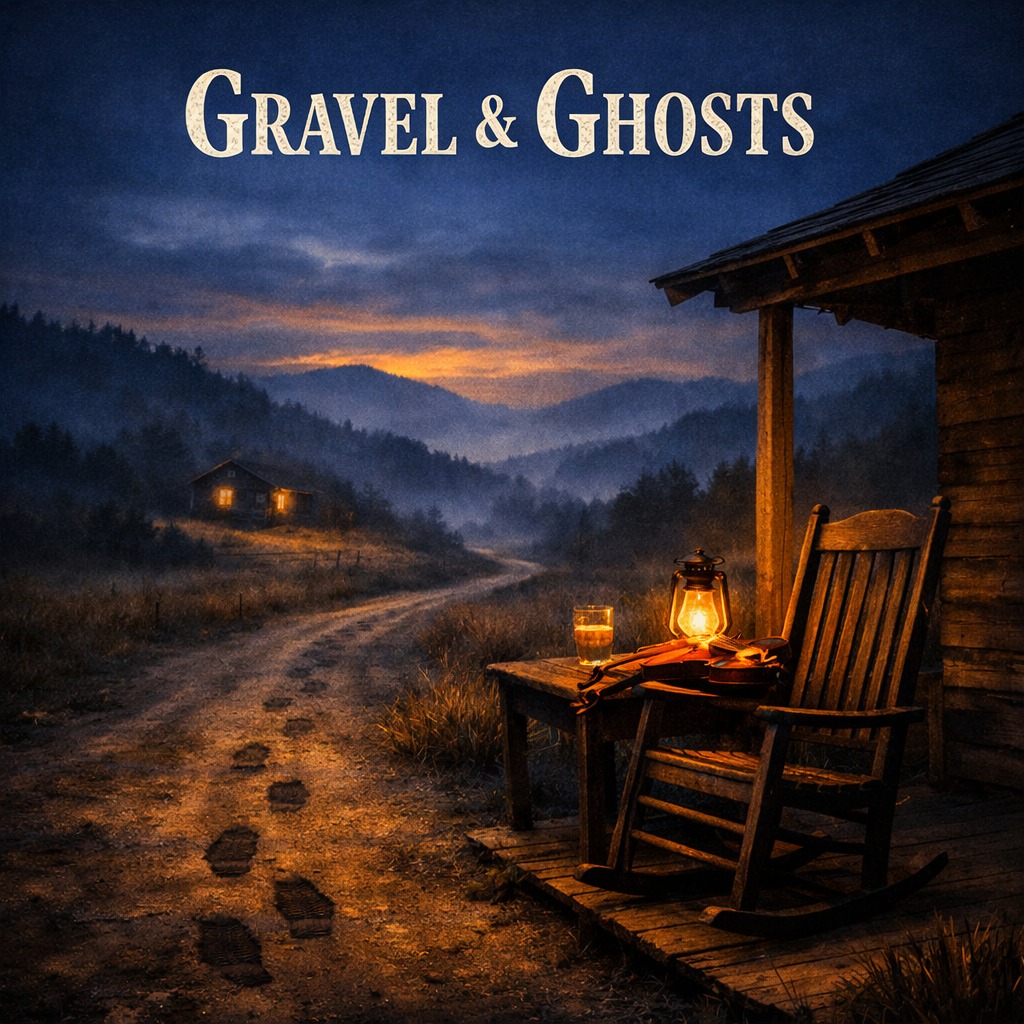
gravel and ghosts
Thank you my good friend Blue Hermit .
I couldn't have made this album without your ears, and input.
·

10 songs
4:23
A slow-burn Appalachian ambient opener built on restraint, intuition, and environmental unease, Sparse banjo plucks and soft mandolin tremolo establish a fragile rhythmic bed while a high, thin fiddle motif (B–G–F#) introduces an unresolved presence that subtly threads through the track, Rhythm emerges gradually via an uneven heartbeat kick and minimal boom bap pulse, preserving tension rather than release, Low-gain ambient guitar adds a muted alt-grunge undercurrent beneath organic textures, Vocals remain intimate and close-mic, moving from whispered uncertainty to controlled unease without fully breaking, Lyrically, the song avoids explanation, grounding itself in physical sensation and subtle disruption, Environmental sounds—wind, insects, wood creaks—function as instrumentation, reinforcing the sense that something has been present long before it was noticed
4:21
Just in My Head
v5.5
A minimalist Appalachian noir piece centered on denial and psychological fracture, Sparse mandolin tremolo and isolated banjo notes create an unstable foundation, while a high, thin fiddle motif (G–Eb–D) introduces a recurring, unresolved presence that feels internalized rather than external, Rhythm is nearly absent, allowing breath, phrasing, and silence to carry emotional weight, Ambient guitar and soft sub bass provide depth without grounding the listener, Vocals remain intimate and conversational, gradually revealing strain beneath self-soothing repetition, The chorus loops like reassurance but begins to feel unreliable, subtly cracking in the final pass, The arrangement prioritizes absence and restraint, creating a suspended atmosphere where perception blurs and certainty breaks down—bridging external unease into internal doubt before the narrative turns outward again
3:52
Came in With Me
v5.5
A rhythmic turning point where uncertainty locks into realization, Tight mandolin chop and rolling banjo establish a grounded boom bap groove, with punchy kick and rim driving forward momentum, The fiddle shifts from distant ambience to sharp, intrusive accents, introducing a recurring motif (E–C–B) that now feels immediate and unavoidable, Low-gain electric guitar adds a subtle alt-grunge edge beneath the acoustic core, Vocals move from observational to declarative, sitting forward with controlled grit and growing intensity, The arrangement prioritizes rhythm and presence over atmosphere, marking the shift from questioning perception to recognizing attachment, Tension no longer lingers in the background—it embeds itself within the narrator, turning the unseen into something inseparable
3:32
A tense, rhythm-driven piece built on repetition, control, and rising anxiety, Tight mandolin chop and rolling banjo lock into a forward-moving boom bap groove, creating a sense of constant motion and pressure, Punchy drums and low-gain electric guitar add grit without overcrowding the arrangement, A high, thin fiddle motif built on D–Bb–A cuts through with clipped, uneasy phrasing, shifting from subtle presence to intrusive tension, Vocals are breath-forward and rhythmic, delivering lines like internal commands that loop and intensify, The structure relies on repetition as a psychological device, with phrases becoming more urgent and less stable over time, Minimal layering keeps the focus on groove and vocal delivery, allowing tension to build through control rather than chaos, capturing the moment where discipline breaks down into fear
3:31
I Didn’t Do That
v5.5
A psychologically fractured boom bap track where identity begins to split under pressure, Tight mandolin chop and rolling banjo maintain a forward groove, while punchy drums anchor the rhythm as subtle timing inconsistencies introduce unease, A high, thin fiddle motif built on F–Db–C becomes increasingly intrusive, reinforcing the sense of internal takeover, Low-gain electric guitar adds a gritty undercurrent beneath the acoustic core, Vocals remain rhythmically grounded but gradually destabilize, supported by a slightly offset doubled layer that suggests a second presence sharing control, Repetition and phrasing create tension without added density, allowing the track to feel both locked-in and unstable, The result is a controlled unraveling, where physical action continues but personal agency slips away
3:48
What Did I Do
v5.5
A detached Appalachian boom bap piece that explores the aftermath of lost control, A steady groove built on muted mandolin chop, rolling banjo, and subdued drums keeps the track moving forward, while the emotional center remains distant and hollow, A high, thin fiddle motif built on A–F–E lingers quietly, reinforcing a persistent internal presence, Ambient guitar textures add depth without grounding the listener, Vocals are calm and observational, delivered with slight delay and emotional drift, as if recounting events without ownership, Repetition in the chorus feels empty rather than reassuring, emphasizing memory gaps and disconnection, The arrangement maintains motion while emotional awareness lags behind, capturing a state where actions have occurred but understanding has not yet caught up
3:47
A restrained Appalachian boom bap piece centered on quiet acceptance and unresolved coexistence, Open mandolin strums replace percussive chop, while banjo settles into a steady, hypnotic roll that anchors a softened groove, Subtle drums provide forward motion without urgency, and ambient guitar textures create a gentle, spacious foundation, A high, thin fiddle motif built on C–Ab–G lingers with warmth rather than tension, suggesting a presence that no longer resists but remains unresolved, Vocals sit slightly behind the beat, relaxed and grounded, delivering lines with calm detachment and understated weight, Repetition becomes soothing rather than anxious, reinforcing a sense of adaptation rather than control, The arrangement avoids dynamic peaks, allowing stillness and space to carry the emotional tone, resulting in a quiet, ambiguous peace where presence is accepted but not fully understood
4:22
Me, Always Was
v5.5
An intimate Appalachian ambient piece centered on internal realization rather than external conflict, The arrangement is stripped to its bare essentials—sparse mandolin plucks, minimal banjo, and a soft pulse replacing traditional rhythm, Fiddle carries a subdued motif (A–F–E), no longer threatening but integrated, like a recurring thought, Vocals are close-mic’d and deliberate, sitting slightly behind the beat to emphasize reflection and acceptance, There is no dramatic lift; emotional weight comes through phrasing and silence, The track shifts the narrative from coexistence to identity, revealing that what once felt external has always been internal, The result is calm but deeply unsettling—less a resolution than a recognition that cannot be undone
4:32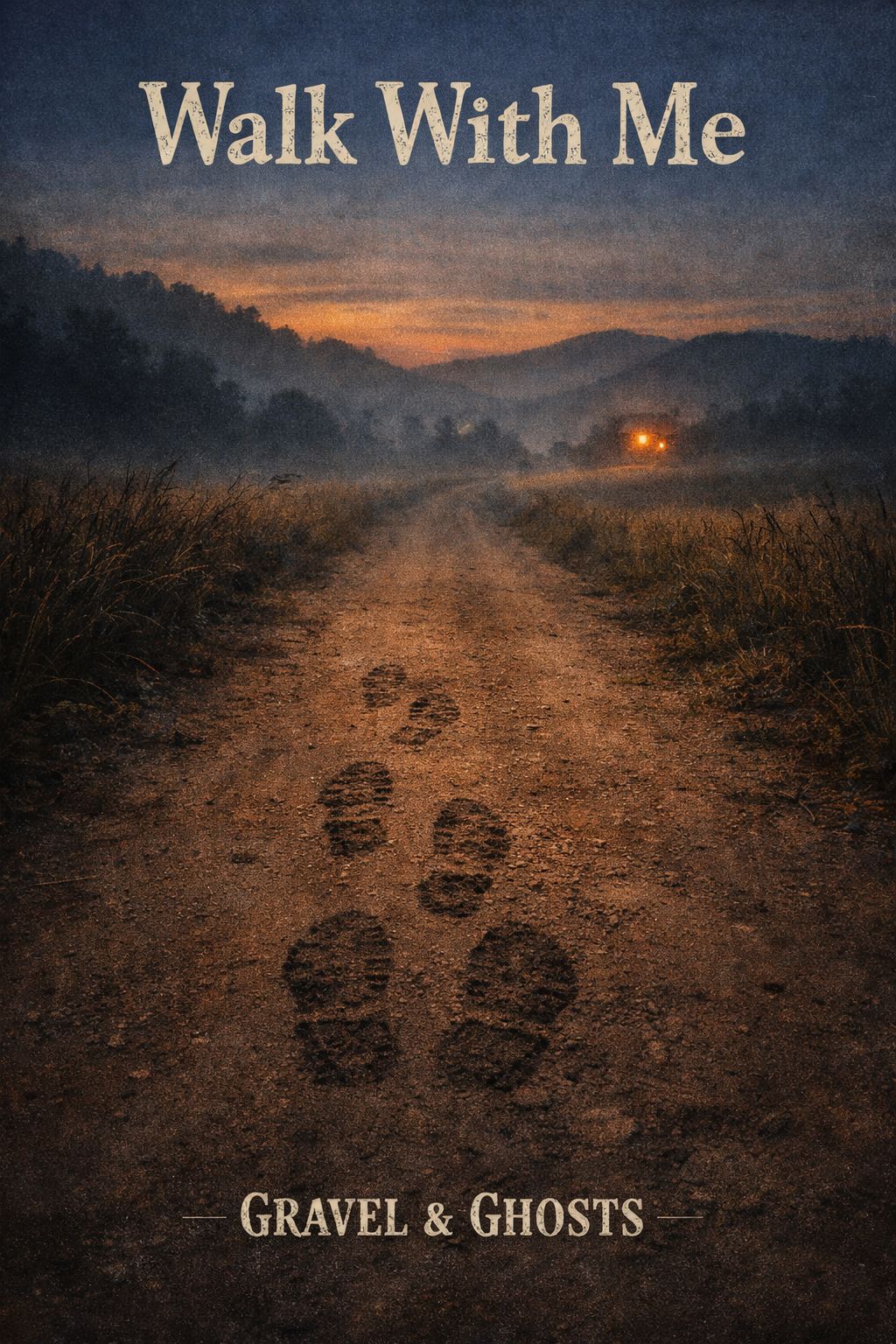
Walk With Me
v5.5
A spacious Appalachian ambient closer built on warmth, restraint, and quiet acceptance, Open mandolin strums replace earlier tension, while banjo becomes sparse and supportive, The fiddle introduces a gentle motif using B–G–F#, no longer intrusive but calm and integrated, signaling full internal alignment, A soft boom bap pulse enters subtly, supporting rather than driving the track, Ambient guitar textures widen the space without drawing focus, Vocals are intimate, steady, and slightly behind the beat, emphasizing grounded presence and emotional clarity, The arrangement relies on silence, phrasing, and natural decay rather than dynamic shifts, The result is peaceful but unresolved—an ending that doesn’t resolve the tension, but learns to live with it, allowing the journey to continue in quiet understanding